
WhatsApp is your sales channel. It's also your exposure.
A WhatsApp chat on an agent's personal phone leaves the business when the agent does, and produces nothing if anyone ever asks for the record.
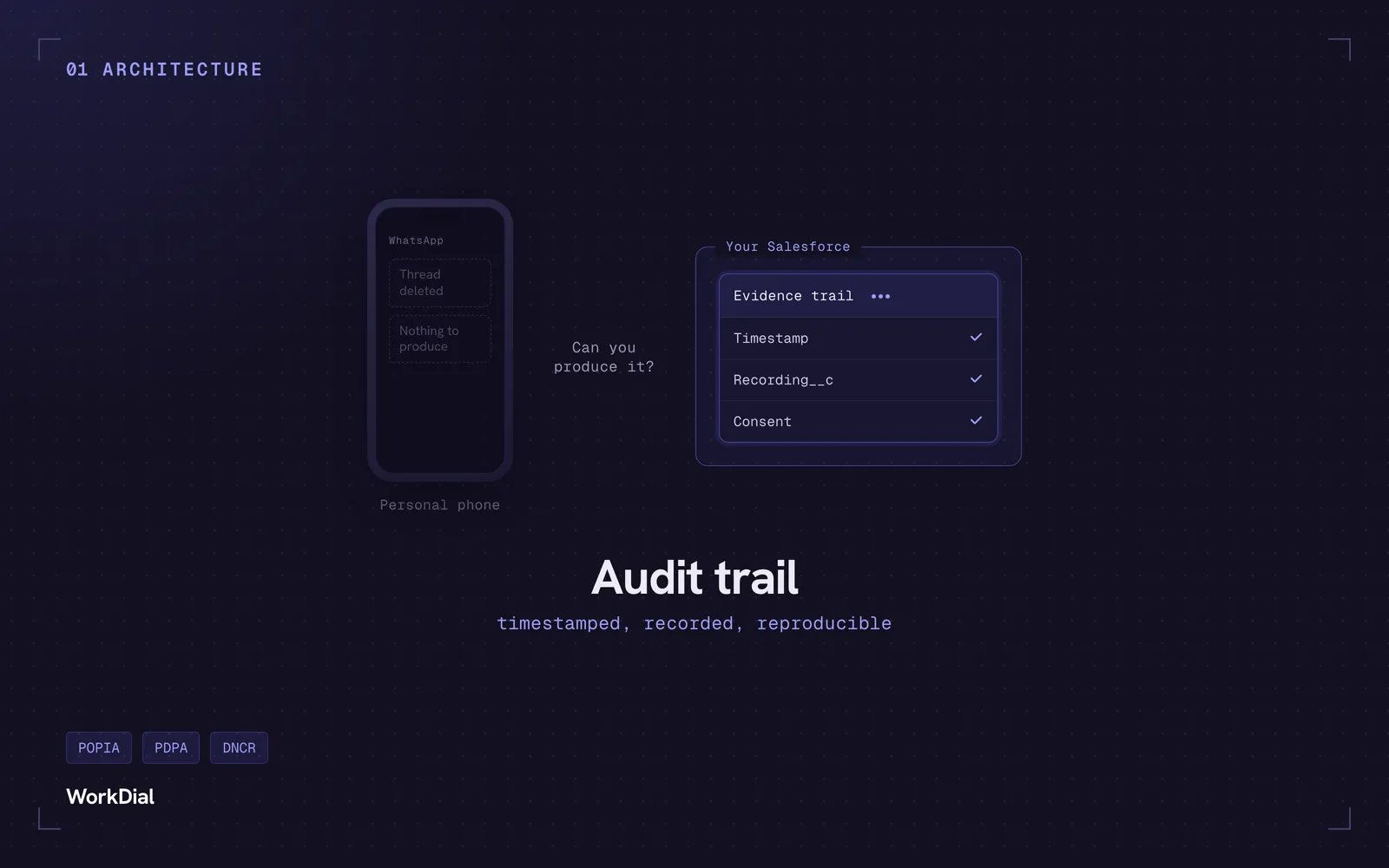
A client viewing a listing on Bayut messages the agent on WhatsApp to book a viewing. The agent replies from a personal phone, on a personal number, inside a personal app. Nobody outside that thread logged the message, and nobody but the agent has ever seen the number the client used to reach the business.
That is not a hypothetical for firms selling through Bayut, Property Finder, PropertyGuru, or Property24. It is the default. WhatsApp-first selling puts the entire client relationship inside an app the business does not control, on a device the business does not own. WorkDial, a Salesforce-native CTI platform, exists to move that conversation onto the record before either problem shows up.
A PropertyGuru inquiry in Singapore, a Property24 lead in Johannesburg, a Bayut viewing request in Dubai: whichever portal a lead starts on, the conversation that actually closes the deal almost always finishes on WhatsApp, not inside whatever system generated the lead in the first place.
Who owns that WhatsApp thread, you or the agent holding the phone?
Ownership follows the phone, not the org chart, and on a personal device the phone belongs to the agent. Every number a client texts, every viewing scheduled, every price floated lives in a thread the business has never opened and cannot search.
The CRM shows a lead record. The phone shows the actual relationship: the back-and-forth on financing, the second viewing that got rescheduled, the number the client will call back on next month. None of that belongs to the business unless it was written somewhere the business holds.
A sales manager checking that same lead in Salesforce sees a status of “in progress” that has not moved in six weeks, with no way to tell whether the agent is actively negotiating a price or has stopped responding to the client altogether. The activity is real. It is happening on a device the manager has no visibility into.
What happens the day that agent leaves
The buyer’s history, the number, and whatever negotiation was mid-flight leave with the agent, because none of it was ever written anywhere the business held a copy. A PropertyGuru lead an agent has been working for three weeks does not hand back to the desk when the agent resigns; it walks out on the agent’s phone, and the next call the client gets is usually from wherever that agent lands next.
Three weeks of qualifying questions, two rescheduled viewings, and a price the client floated verbally on a call all leave in the agent’s pocket along with the number. The business is left rebuilding a relationship it never actually owned in the first place, with a client who has already moved on to whoever kept the number.
A screenshot is not a business record
A screenshot pulled from an agent’s phone after the fact has no consent trail, no timestamp the business controls, and no guarantee it existed before someone thought to ask for it. A client dispute, a regulator’s request, or a departing agent’s last thread all land on the same problem: the business has nothing of its own to produce.
No software, WorkDial included, makes a business compliant with the rules that govern how it contacts, records, and stores a client’s data. A firm selling across Johannesburg, Singapore, and Dubai can answer to South Africa’s POPIA, Singapore’s PDPA, and a Do Not Call Registry (DNCR) at the same time, and that obligation sits with the business, not with any tool it buys. What changes with a Salesforce record is whether the business has anything to produce at all: a consented interaction, recorded and timestamped at the moment it happened, pulled from its own system instead of reconstructed from memory or a screenshot that might not exist anymore. That is the argument behind why call data belongs in Salesforce: a record assembled after the fact is not the same evidence as one written at the source.
Every WhatsApp interaction becomes a Salesforce record the moment it happens
A recorded WhatsApp voice call placed from the Salesforce record, or a chat opened from it, logs to that record automatically, with no manual step for the agent to complete or skip. The chat itself opens from the record with the client’s number masked, so the agent works the lead without ever seeing or owning the number that would otherwise leave with them.
That is the mechanism behind the vertical problem above: the number never sits on the agent’s personal device in the first place, so there is nothing for the agent to walk out with. What that looks like day to day for an agent and an admin is covered on works inside Salesforce, and the lead-ownership case for it in more depth sits on WhatsApp and who really owns the lead.
Where transcription is enabled, the transcript, sentiment score, and AI summary attach to the record alongside the recording, automatically, included in the plan rather than billed as a separate add-on. That matters most on the day an agent leaves: a replacement can read the last six weeks of a negotiation from the record in minutes, instead of calling the client to ask what was already discussed.
You choose where the recording lives
The recording goes to native Salesforce Files inside the customer’s own org, the customer’s own Twilio account, or the customer’s own cloud storage, whichever the customer configures. WorkDial writes to that destination and keeps no copy of its own, and native Salesforce Files is a choice no rival in this field offers, since it never leaves the org the record lives in.
Access to the recording runs on Salesforce’s own permission model: profiles, permission sets, field-level security, and sharing rules the admin already manages for every other object in the org. There is no separate vendor console governing who can listen to a call. In transit, the connection runs on TLS 1.2+, and encryption is inherited from Salesforce rather than layered on separately. The fuller detail sits on security; this post is the summary, not the substitute.
The record outlasts the agent who created it
Once the interaction is written to the record at the moment it happens, the business can pull the recording, the timestamp, and the transcript any time it needs them, whether the agent who took the call is still on the team or not. A conversation is a company asset, and it should live where the business lives, inside Salesforce, not on a phone that quits.
That is what actually changes for a real estate desk running on WhatsApp: the lead a departing agent was working stays a business asset instead of becoming a personal contact list, and whoever picks up the account next inherits the history along with the client.
WorkDial is buyable and useful on its own for this. It also pairs with ValueText, the Salesforce-native messaging platform with 4.97 stars across 100+ AppExchange reviews, built by the same team, to put WhatsApp chat, SMS, and voice on one record at a 20% bundle discount, but nothing in this post depends on that pairing.
The next time an agent hands in notice, the question worth asking is not whether they were good at the job. It is whether the client relationship they built ever actually belonged to the business.
Start your trial to see the record written the moment a WhatsApp call happens, no credit card required. If your team wants to work through what that means for a specific market first, talk to sales.
Common questions
- Who owns a WhatsApp conversation that happens on an agent's personal phone?
- The agent does, in practice: the number, the message history, and the relationship all sit on a device the business does not control. If that agent leaves, the client relationship and every log of it leave too, because none of it was ever written to a record the business holds. Routing the same conversation through a Salesforce record fixes that, because the interaction is created on the record instead of recovered from a phone afterward.
- Can a business produce a WhatsApp sales conversation if it's ever asked to?
- Only if the conversation happened somewhere the business controls, not on an agent's personal device. A chat on a personal phone has no timestamp the business can produce independently of the agent, and no guarantee it still exists once the thread is deleted or the agent's employment ends. A conversation logged to a Salesforce record carries a timestamp and, where enabled, a recording, transcript, and sentiment score the business can pull on its own.
- Does WorkDial make a business compliant with local WhatsApp or telemarketing rules?
- No, and no software makes a business compliant on its own with rules like South Africa's POPIA, Singapore's PDPA, or a Do Not Call Registry (DNCR): that obligation belongs to the business collecting and processing the data, not to a vendor. What WorkDial provides is the evidentiary trail those rules typically expect, a consented interaction that is recorded, timestamped, and reproducible from the Salesforce record, which supports the obligation without certifying that a business meets it.
- Where are WhatsApp call recordings stored?
- Wherever the customer chooses: native Salesforce Files inside their own org, their own Twilio account, or their own cloud storage. WorkDial writes the recording to whichever destination is configured and keeps no copy of its own on any infrastructure it operates.
- How does WorkDial keep an agent from ever seeing a client's WhatsApp number?
- The agent opens the WhatsApp chat directly from the Salesforce record, and the number is masked so the agent never sees or owns it. A recorded WhatsApp voice call placed from that same record logs to the record automatically, with no manual step for the agent to complete or skip.
Written by WorkDial, The voice layer of Salesforce. WorkDial is built by the team behind ValueText, the Salesforce-native messaging platform, rated 4.97 stars across 116 AppExchange reviews.
Keep reading
Related posts.
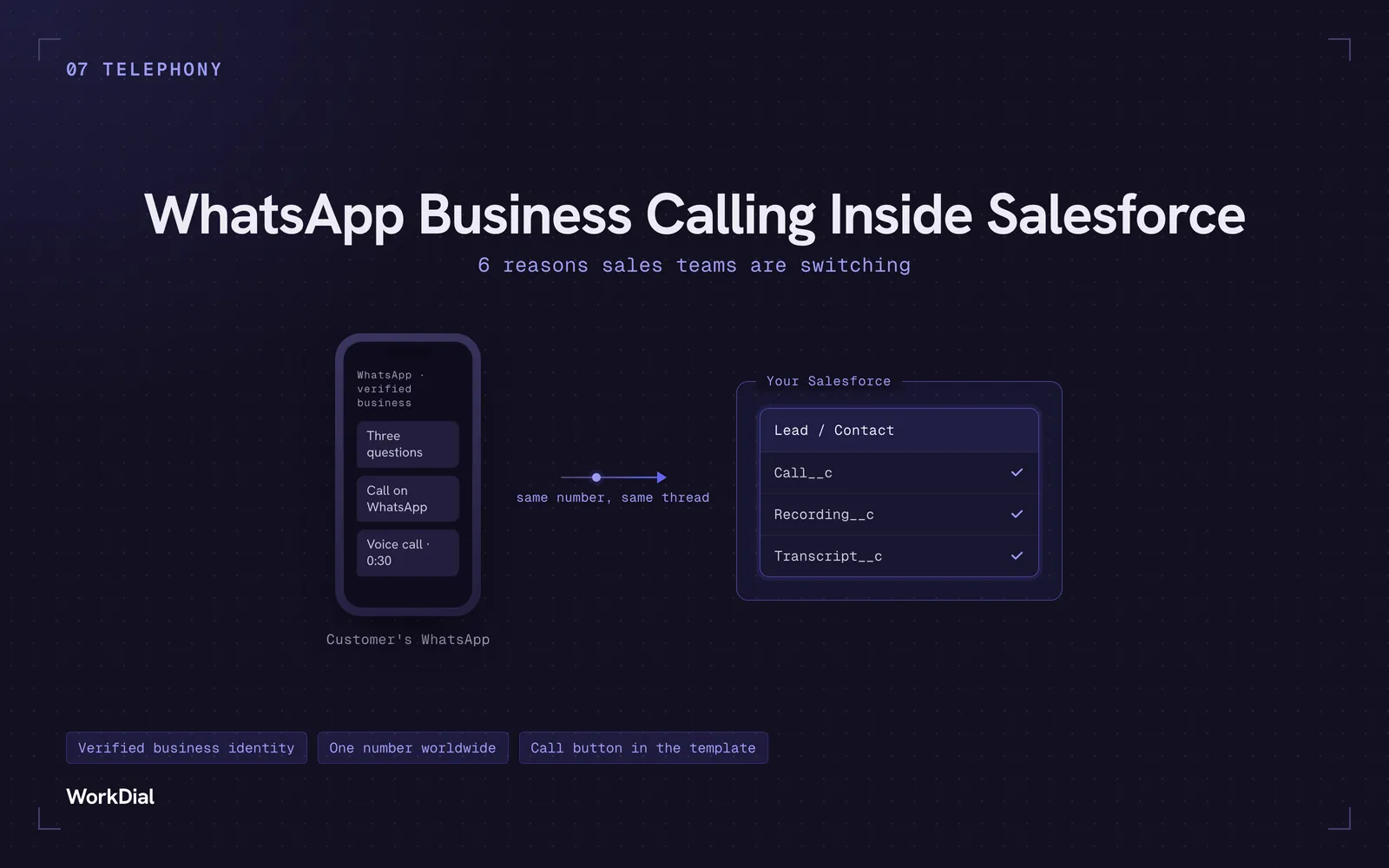
WhatsApp Business Calling Inside Salesforce: 6 Reasons Sales Teams Are Switching
Six reasons sales teams are moving calls onto WhatsApp inside Salesforce: one thread for chat and calls, a verified business identity on every call, one number worldwide, lower cost, a call button in the template, and one record for everything.
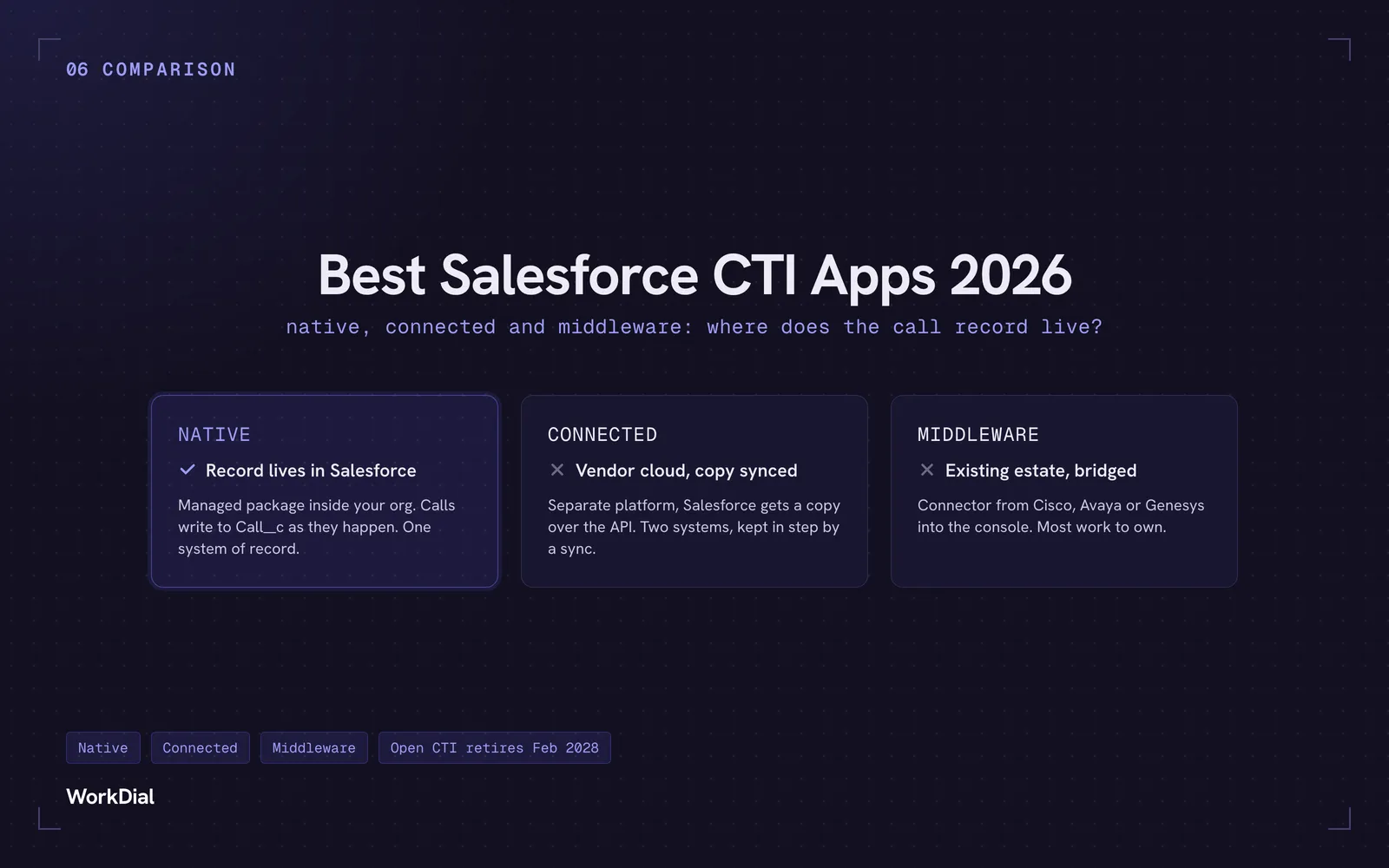
Best Salesforce CTI apps in 2026: native, connected and middleware
The 9 best Salesforce CTI apps in 2026, compared on one thing: where your call record actually lives. Native, connected and middleware, with real pricing.
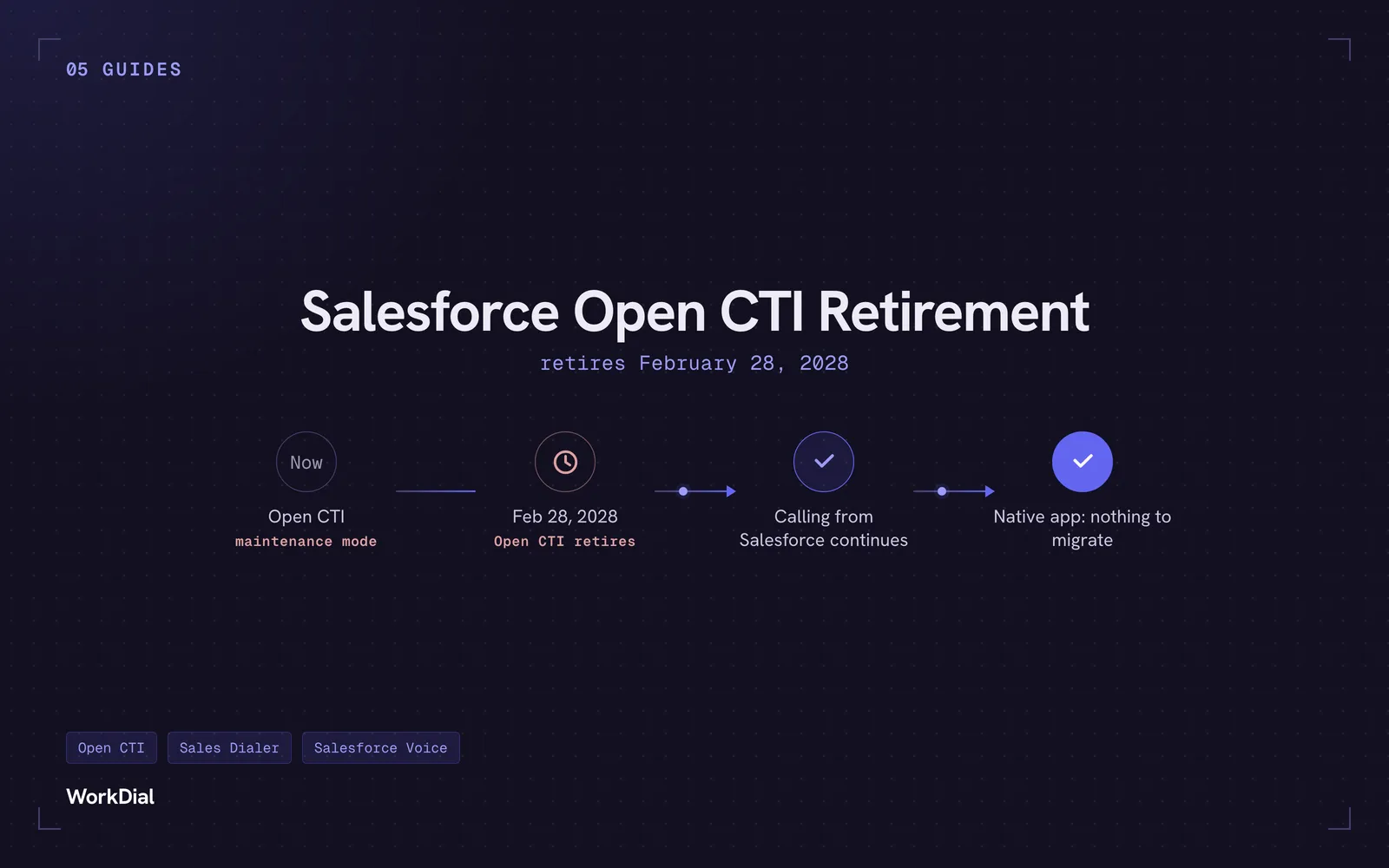
Salesforce Open CTI Retirement: What Actually Happens on February 28, 2028, and Your Real Options
Open CTI retires February 28, 2028. What breaks, what happens to your existing CTI, and how to keep calling in Salesforce without buying new licences.