
Salesforce Open CTI Retirement: What Actually Happens on February 28, 2028, and Your Real Options
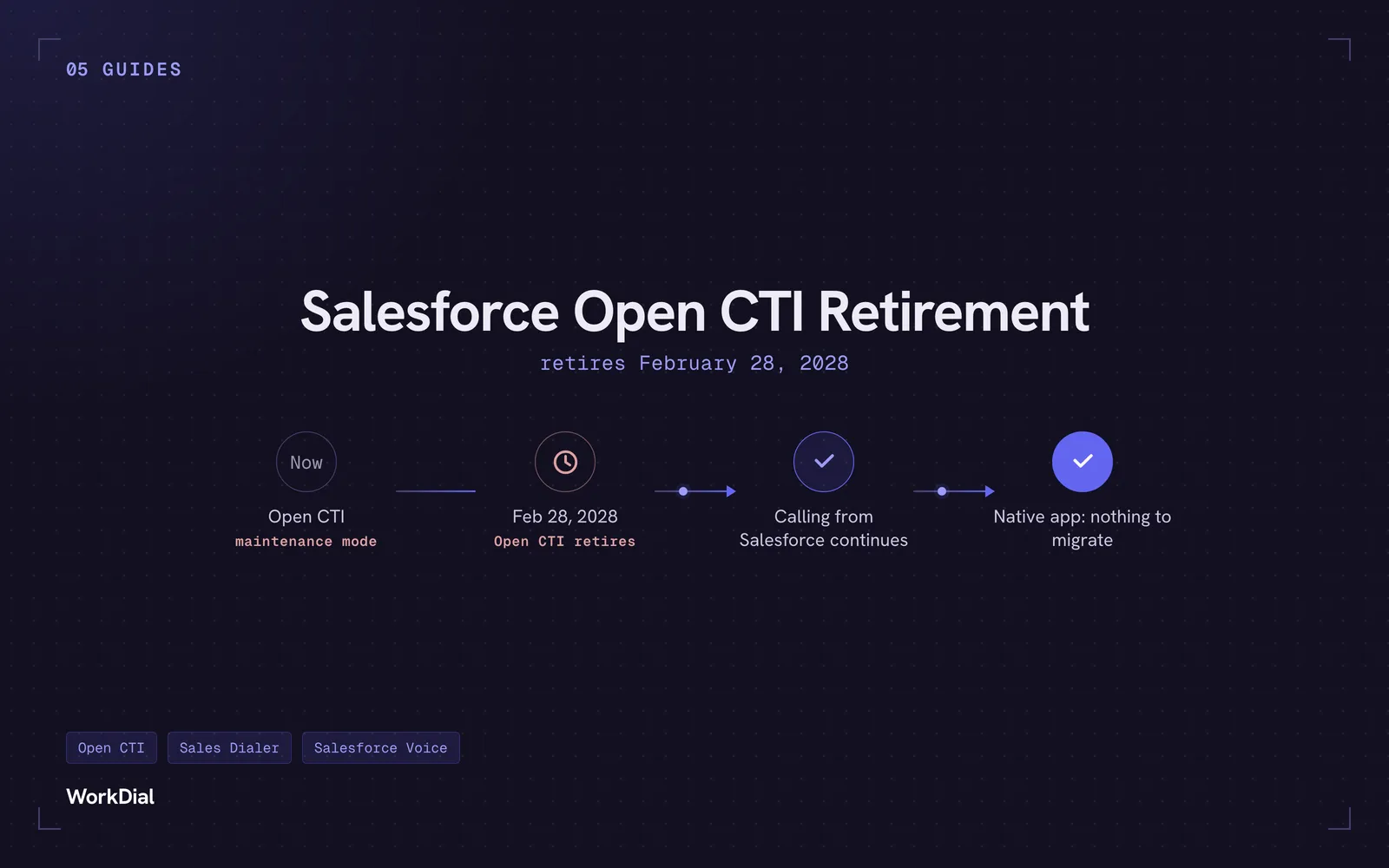
Open CTI retires February 28, 2028. What breaks, what happens to your existing CTI, and how to keep calling in Salesforce without buying new licences.
If you dial from Salesforce today, you probably do not think about Open CTI at all. It is the invisible plumbing. You click a phone number on a Lead, a softphone pops up, the call connects, and the activity gets logged. Nobody in your sales team knows what makes that happen.
That plumbing has a shutdown date now.
Salesforce has confirmed that Open CTI is in maintenance mode and scheduled for retirement in February 2028, February 28, 2028 to be precise. No new features. No enhancements. And for newly created Agentforce Service orgs, it is already unavailable.
Separately, Salesforce Sales Dialer is also flagged as scheduled for retirement in its own Help documentation, with no new features being added and a recommendation to move to Salesforce Voice.
So two things are winding down at once: the framework third-party dialers plug into, and Salesforce’s own built-in dialer.
This post answers the questions that actually come up in every admin conversation we have had about this, not the marketing version.
The short answer: No, you will not lose the ability to call from Salesforce. You will lose one specific method of building phone integrations. Some AppExchange dialers will need to be rebuilt by their vendors. Others, the ones that were never built on Open CTI in the first place, carry on exactly as they are.
WorkDial on the Salesforce AppExchange to make calls from the salesforce.
First, what Open CTI actually is
Open CTI is a browser-based JavaScript API. That is it. It is the bridge Salesforce built so that outside phone systems could reach into the Salesforce user interface.
Salesforce’s own developer documentation describes it as the way to build and integrate third-party computer-telephony integration systems with Salesforce Call Center, letting you place calls from a softphone inside Salesforce without installing CTI adapters on individual machines.
That last part was the big deal in 2012. Before Open CTI there was Desktop CTI, the CTI Toolkit, which required an adapter installed on every single agent’s computer. Anyone who administered a call centre in that era remembers the pain. Open CTI killed the desktop install, and it is why click-to-dial and screen pop became normal.
In practice, Open CTI is what powers three things you take for granted:
- Click-to-dial: clicking a phone number on a record starts the call
- Screen pop: an inbound call opens the matching Contact, Lead or Case
- The softphone in the utility bar: the persistent call panel at the bottom of Lightning
If your reps use any of those and your telephony comes from an external provider, there is a good chance Open CTI is sitting underneath it.
What Salesforce has officially said
Worth separating the confirmed facts from the commentary, because there is a lot of both floating around.
Confirmed, from Salesforce:
| What | Status | Source |
|---|---|---|
| Open CTI | Maintenance mode, retirement February 28, 2028 | Open CTI Developer Guide |
| Open CTI in new Agentforce Service orgs | Deprecated, unavailable already | Open CTI Developer Guide |
| Sales Dialer | Scheduled for retirement, no new features | Sales Dialer, Salesforce Help |
| Desktop CTI (CTI Toolkit) | Already retired | Other Voice Solutions |
| Recommended path | Salesforce Voice | Get to Know Salesforce Voice |
Salesforce’s reasoning, in its developer guide, is that Salesforce Voice is natively integrated with Omni-Channel and Command Center in a way Open CTI never was: one experience across voice and digital channels rather than a JavaScript layer bolted to the side.
That is a fair architectural argument. It is also, unavoidably, a licensing argument. Both things are true at once, and it is worth being honest about that rather than pretending the decision is purely technical.
One important note on Sales Dialer: as of this writing, Salesforce has not published a formal end-of-life date for it the way it has for Open CTI. The Help page says it is scheduled for retirement and points you to the retirements page for the formal date. Check Salesforce Active Product & Feature Retirements for the current list. That page is the source of truth, and it changes.
The five questions everyone asks
1. Can we not make calls from Salesforce anymore?
You can. This is the single biggest misconception.
Open CTI retiring does not mean Salesforce stops supporting telephony. It means one implementation method stops working. Calling from Salesforce continues through Salesforce Voice, through Voice with Bring Your Own Telephony, or through AppExchange applications that do not depend on Open CTI.
After February 28, 2028, Open CTI implementations stop functioning. Salesforce calling does not.
2. What happens to the CTI we already have?
Depends entirely on how your vendor built it.
Between now and the retirement date, existing Open CTI implementations keep working. They just stop receiving new features. After the date, anything built on the Open CTI JavaScript API will break.
So the question to put to your telephony vendor, in writing, is narrow and specific:
“Does your Salesforce integration call the Open CTI JavaScript API? If yes, what is your migration plan and target date? If no, please confirm what it uses instead.”
Ask for that in an email, not on a call. You want the answer on record. Vendors fall into three groups right now: already migrated, actively rebuilding, and quietly hoping nobody asks. The email tells you which one you are dealing with.
3. Are we forced to buy Service Cloud Voice or Agentforce Contact Center?
No, but Salesforce would prefer it, and the recommendation in the documentation points that way.
Be clear-eyed about the cost shape if you go down that road. Salesforce Voice is generally a per-user add-on layered on top of Service Cloud, and telephony minutes are billed separately from the licence. At real call volume, the minutes often end up costing more than the seats. If you are also looking at Agentforce Voice on top, that is consumption-based credits as a third line item.
None of which makes it the wrong choice. For a large omni-channel contact centre that is already deep in Service Cloud and wants routing, supervisor tooling and AI in one stack, it is a very reasonable investment. For a 15-person sales team that just wants click-to-dial and clean call logging, it is an enterprise contact centre platform priced like one.
Model your own numbers against the official Service Cloud Voice pricing page before anyone signs anything.
4. Can you make calls from Salesforce without Open CTI?
Yes, and this is the part that gets lost in the noise.
Open CTI was never the only way to build a dialer. It was the standard way to embed an external softphone. An application built with Lightning Web Components, Apex, and Salesforce’s standard platform APIs, using a voice SDK directly rather than the Open CTI bridge, never touched Open CTI at all.
Those apps do not need to migrate. There is nothing to migrate from. February 28, 2028 is a normal Monday for them.
This is the practical difference between a bolt-on integration, where an external softphone reaches into Salesforce through Open CTI, and a native one, where the dialer is built on the Salesforce platform itself. For years the distinction was mostly a talking point in sales decks. The retirement date turned it into a real one.
5. Will AppExchange and AgentExchange apps stop working?
Not as a category. Individually, some will.
AppExchange itself is not affected by this. What is affected is any specific listing whose code calls the Open CTI API. Those vendors have to ship a rebuilt version before the deadline, or their customers lose calling.
Practical audit steps for your own org:
- Setup, then Call Centers. An entry here is a strong Open CTI signal.
- Installed Packages. List every telephony-related managed package.
- Check whether a softphone appears in your utility bar, and which package puts it there.
- Search your vendor’s documentation for “Open CTI”. Most technical docs mention it explicitly.
- Ask any custom-developed integrations’ original developer the same question.
Do this now while it is a calendar item, not later when it is an incident.
Your three realistic paths
Path A: move to Salesforce Voice. Salesforce’s recommended route. Deepest integration with Omni-Channel, Command Center and Agentforce. Additional per-user licensing plus separately billed telephony. Best fit for larger contact centres already standardised on Service Cloud.
Path B: Salesforce Voice with Bring Your Own Telephony. Keep your existing carrier or platform for the voice infrastructure, and use the Salesforce Voice agent experience on top. Reduces carrier switching cost. Still needs the Voice licences, and needs your provider to actually support the BYOT model, so confirm rather than assume.
Path C: a Salesforce native AppExchange app with no Open CTI dependency. No additional Salesforce licence. Nothing to migrate. The trade-off is that you are relying on a vendor’s platform rather than Salesforce’s own, so vendor diligence matters more.
There is also the option nobody wants to say out loud: do nothing and let your current vendor solve it. That is fine if you have received a written migration commitment with a date. Without that, it is not a plan, it is a hope.
Where WorkDial fits
Full disclosure before anything else: we build WorkDial. Treat what follows as a vendor’s position, verify the claims yourself, and hold us to the same written-confirmation standard we told you to apply to everyone else.
WorkDial is 100% Salesforce native and does not depend on Open CTI. It was built on Lightning Web Components and Apex from the start, which means the February 2028 date requires no action from WorkDial customers. Not a migration, not an upgrade path, not a “we are working on it”.
What it does:
- Quick dialer on any record page. Lead, Contact, Opportunity, Case, custom objects. One click from where the rep already is.
- Automatic call recording and call logging. Every call written as a native Salesforce record when it ends, not synced in from an external database on a delay.
- AI agent for recordings and transcripts. Transcription and summaries against the call, stored on the record.
- Bulk and list view calling. Work a filtered list view or report without leaving Salesforce.
- Calls initiated from Salesforce Flow. Voice as a step in your existing automation, not a separate silo.
- WhatsApp calling alongside standard voice.
Find WorkDial on the Salesforce AppExchange.
Want to see it against your own org’s setup? Book a 30-minute demo
A migration checklist you can actually run this quarter
- Audit. Setup, then Call Centers, plus every installed telephony package. Write down what you find.
- Ask. Email every telephony vendor the Open CTI dependency question. Set a two-week deadline for a written answer.
- Triage. Sort the answers into no dependency, vendor migrating with a date, and no clear answer.
- Cost the alternatives. Get real numbers for the Salesforce Voice route including telephony minutes at your actual volume. Get real numbers for at least one native AppExchange alternative.
- Inventory your customisations. Custom Apex, Flows, or Lightning Web Components that hook into your current CTI are where migrations overrun. Find them before you scope.
- Pilot. One team, thirty days, real calls. Whatever you choose.
- Decide by mid-2027 at the latest. That leaves genuine buffer. Complex contact centre migrations are commonly scoped in months, not weeks, and everyone in the market will be doing this at the same time in late 2027.
The organisations that will struggle are not the ones with complicated setups. They are the ones that find out in January 2028.
Official Salesforce resources
Bookmark these rather than relying on secondhand summaries, including this one.
- Open CTI Developer Guide, Get Started (the retirement notice, at source)
- Open CTI Developer Guide, Other Voice Solutions
- Open CTI Backward Compatibility
- Salesforce Open CTI Retirement Knowledge Article
- Salesforce Active Product & Feature Retirements
- Get to Know Salesforce Voice
- Sales Dialer, Salesforce Help
- Salesforce Product & Feature Retirement Philosophy
FAQ
When exactly does Open CTI retire?
February 28, 2028. Until then existing implementations continue working, but Open CTI is in maintenance mode with no new features or enhancements.
Will I lose the ability to make calls from Salesforce?
No. Open CTI retiring removes one method of building telephony integrations. Calling continues through Salesforce Voice, Voice with Bring Your Own Telephony, or AppExchange apps that do not depend on Open CTI.
How do I know if my org uses Open CTI?
Check Setup, then Call Centers, review your installed telephony packages, and see whether a softphone appears in your utility bar. If your reps use click-to-dial or screen pop with an external phone provider, Open CTI is likely involved. Confirm with your vendor in writing.
Do I have to buy Service Cloud Voice or Agentforce Contact Center?
No. It is Salesforce’s recommended path, and it is a strong fit for larger contact centres, but it adds per-user licensing plus separately billed telephony minutes. Salesforce native AppExchange dialers that never used Open CTI are a valid alternative with no additional Salesforce licence.
Can a Salesforce dialer work without Open CTI?
Yes. An app built on Lightning Web Components, Apex and standard Salesforce APIs, using a voice SDK directly rather than the Open CTI bridge, has no Open CTI dependency and needs no migration.
Will AppExchange or AgentExchange telephony apps stop working?
Not as a category. Individual listings that call the Open CTI API will stop working unless the vendor ships a rebuilt version before the deadline. Ask each vendor directly.
Is Salesforce Sales Dialer also being retired?
Salesforce Help states Sales Dialer is scheduled for retirement with no new features being added, and recommends moving to Salesforce Voice. Check the Active Product and Feature Retirements page for the current formal date.
How long should a migration take?
It varies with complexity, and custom Apex or Flow logic tied to your current CTI is the usual source of overrun. Inventory those before you scope, and decide well before 2028, because the whole market will be migrating in the final months.
Written by the WorkDial team. WorkDial is a Salesforce native CTI and voice application on the AppExchange, built by the team behind ValueText. All Salesforce product statuses above link to primary Salesforce documentation. Retirement dates and pricing can change, so verify at the source before making a decision.
Last updated: August 2026
Written by WorkDial, The voice layer of Salesforce. WorkDial is built by the team behind ValueText, the Salesforce-native messaging platform, rated 4.97 stars across 116 AppExchange reviews.
Keep reading
Related posts.
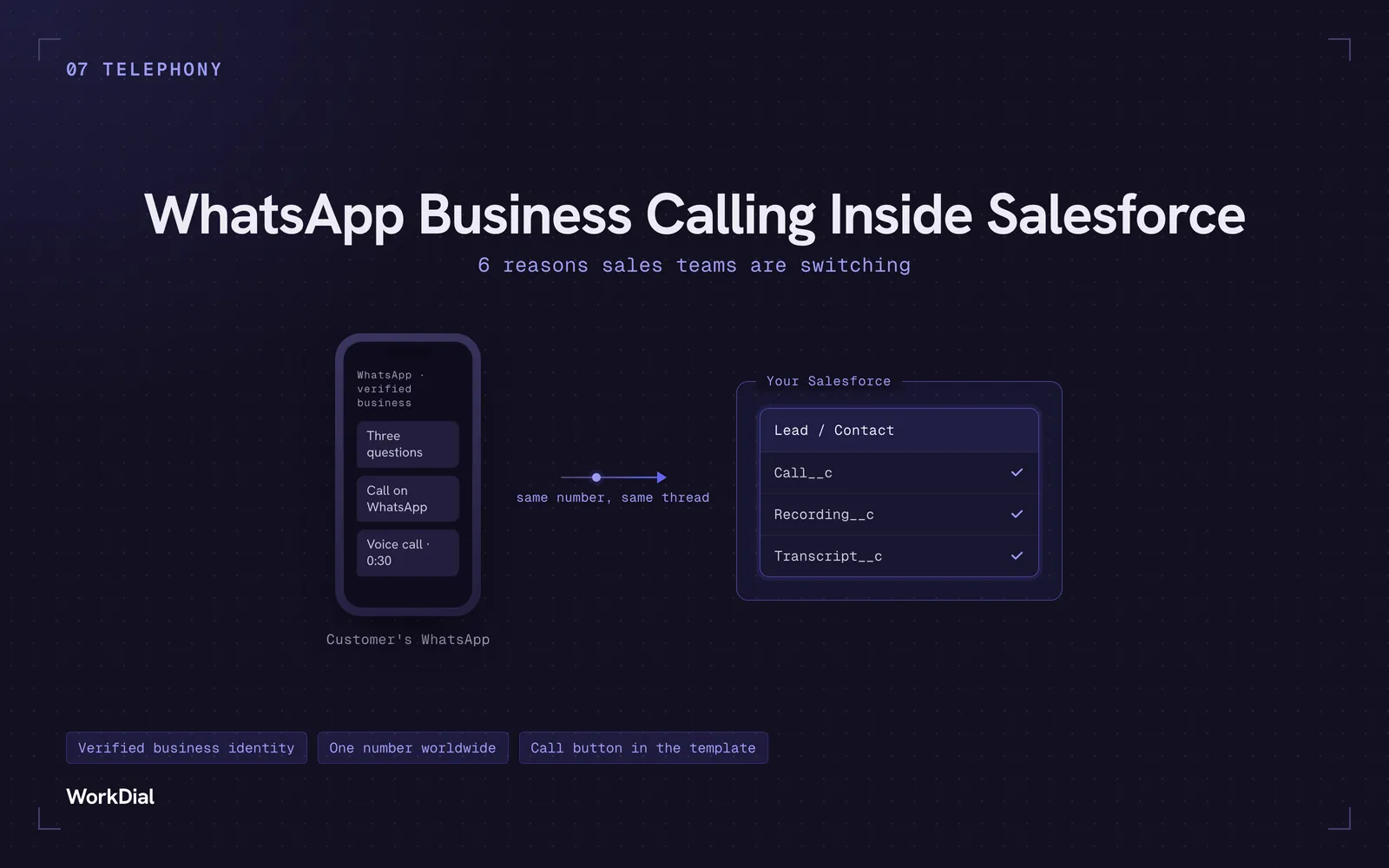
WhatsApp Business Calling Inside Salesforce: 6 Reasons Sales Teams Are Switching
Six reasons sales teams are moving calls onto WhatsApp inside Salesforce: one thread for chat and calls, a verified business identity on every call, one number worldwide, lower cost, a call button in the template, and one record for everything.
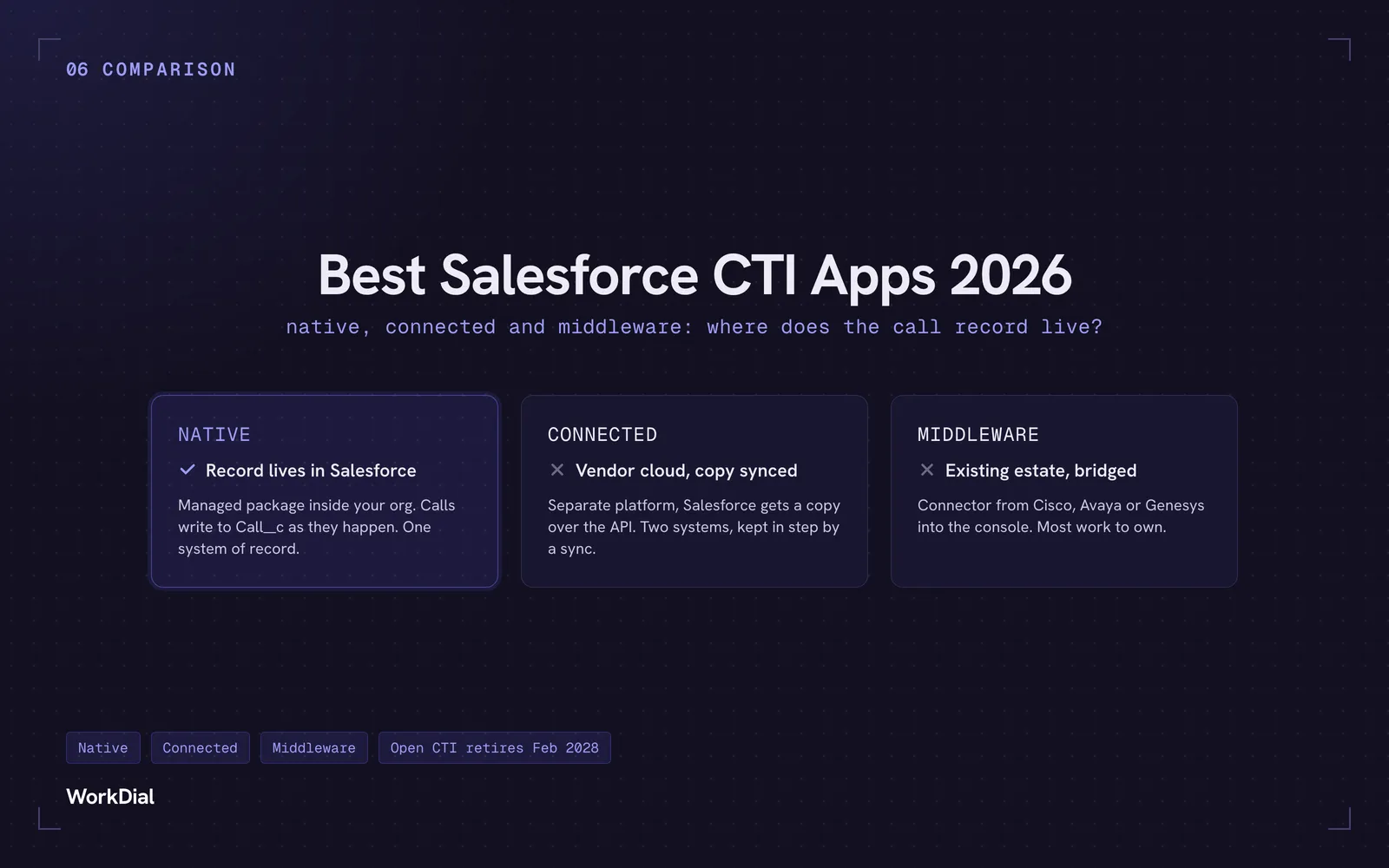
Best Salesforce CTI apps in 2026: native, connected and middleware
The 9 best Salesforce CTI apps in 2026, compared on one thing: where your call record actually lives. Native, connected and middleware, with real pricing.
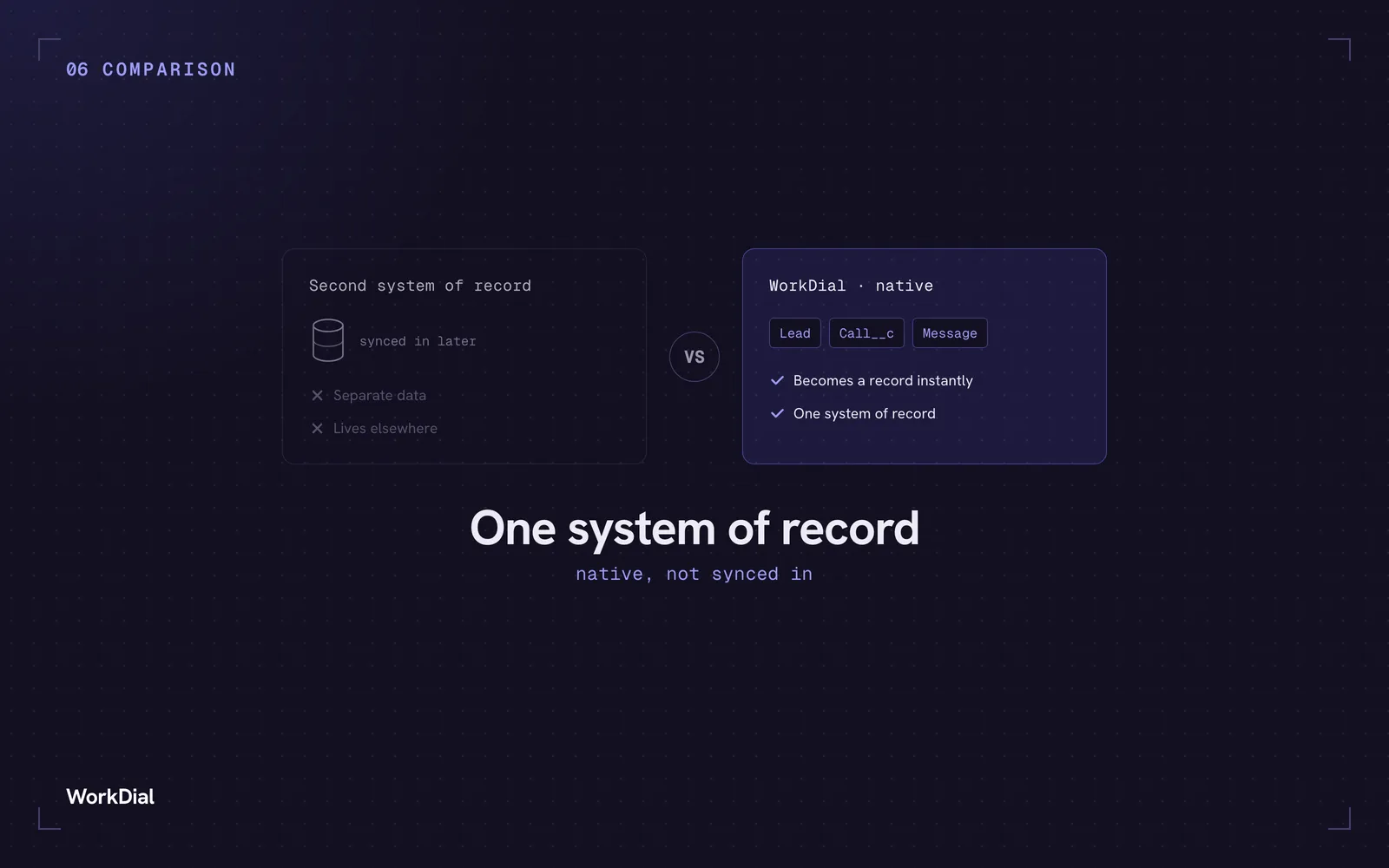
You bought Salesforce for one system of record. Why does your WhatsApp live somewhere else?
Native Salesforce CTI means the call and the WhatsApp message become Salesforce records the instant they happen, not copies synced in from a second system.