
Your agents are on their personal WhatsApp. Your leads are leaving with them.
When an agent quits, the leads on their WhatsApp quit with them. The fix: keep messages and calls on the Salesforce record, not a phone.
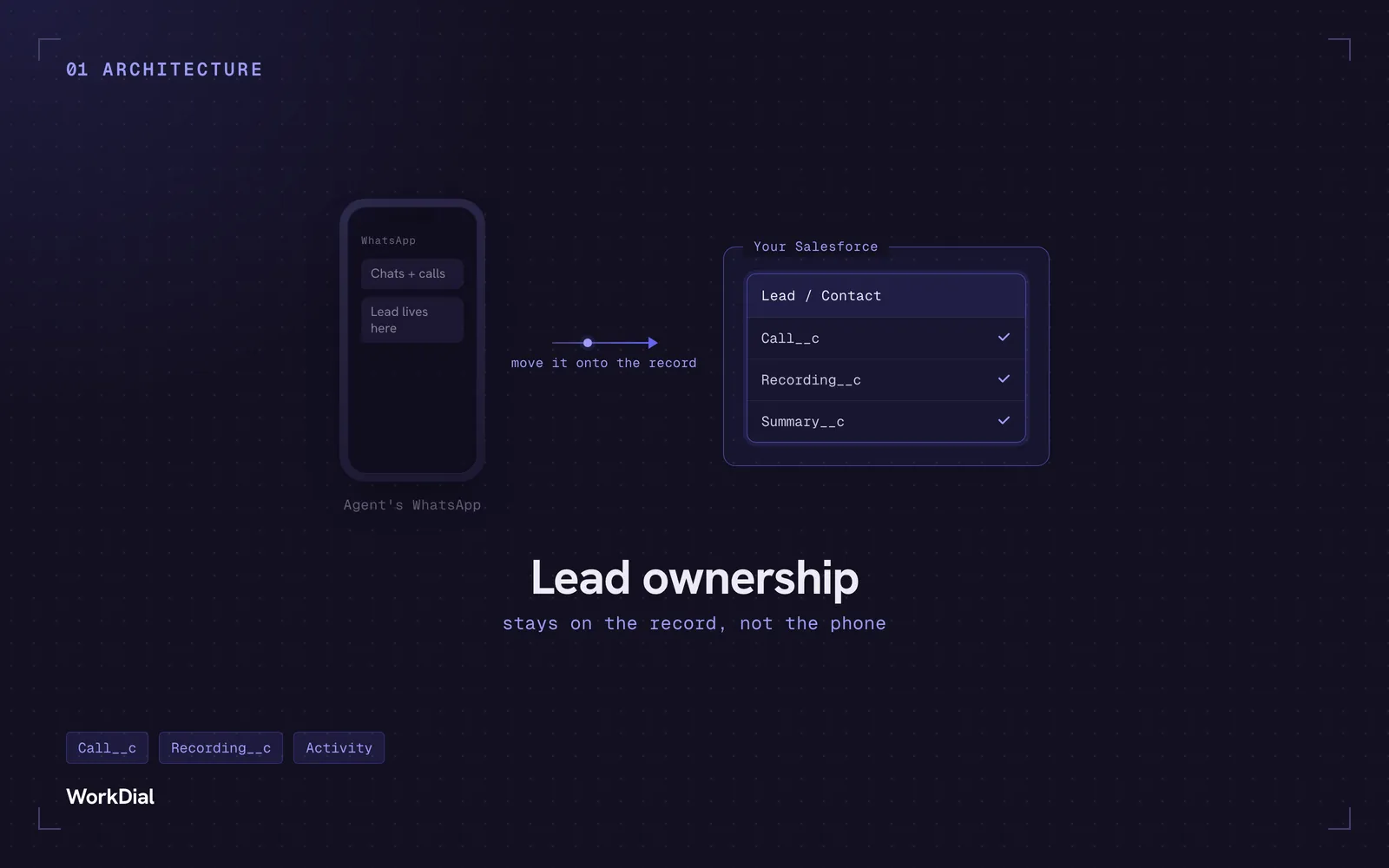
A buyer messages an agent about a listing on Property24, Bayut, or PropertyGuru. The agent replies from a personal phone, on WhatsApp, because that is where the client already is. Weeks of viewings, price negotiation, and follow-up happen in that one thread. Then the agent resigns, and the phone leaves the building with everything still in it.
This is not a hypothetical. It is the pattern real estate teams in South Africa, Singapore, and the UAE describe unprompted: agents copy client numbers into their personal WhatsApp, and when they leave, the leads leave with them. The fix is not a memo telling agents to stop. It is moving the conversation itself. The conversation is a company asset, and it should live where the business lives, inside Salesforce, not on a phone that quits.
Who actually owns the customer, you or the agent holding the phone?
Whoever holds the number and the message history owns the relationship, and today that is usually the agent, not the firm. The client’s number sits in the agent’s personal contacts. The chat history sits in the agent’s personal WhatsApp backup. Nothing about that setup belongs to the business, even though the business paid for the portal listing and the ad spend that produced the lead.
That gap is easy to miss while an agent is still employed and performing well. It only becomes visible, and expensive, at the moment the relationship changes hands, whether that is a promotion, a leave of absence, or a resignation.
What happens to a lead the day an agent quits?
Every message, call, and negotiating detail tied to that client leaves with the agent’s personal phone: no handover, no manager visibility while it was happening, and no record for the next agent to work from. Real estate has high agent turnover by industry norm, so this is not a rare event, it is a recurring line item.
The cost is not abstract. A firm pays per lead through portal listings and paid marketing, then loses that same lead the moment the agent who worked it walks out the door. Nobody decided to write that money off. It happened by default, because the record of the relationship was never anywhere the firm could see.
What happens when an agent places a WhatsApp voice call from the Salesforce record?
The agent sends a WhatsApp call request directly from the lead or contact record, and once the client accepts, the call connects. From that point the call is recorded and logged to the record automatically, with no separate step and no manual note afterward. WorkDial was first to market with WhatsApp voice calling built this way, placed from inside Salesforce rather than from a phone’s dial pad.
The client experience barely changes: a call request arrives on WhatsApp, they accept it the way they would accept any WhatsApp call, and the conversation happens as normal. What changes is where that call lives afterward. It is not a missed call log on someone’s personal phone. It is a call attached to the exact lead it belongs to, the moment it ends. The request-and-accept mechanics are covered in more depth on Salesforce WhatsApp calling.
What shows up on the record once the call ends?
An AI-generated summary and a sentiment read attach to the same record the call was logged against, without anyone typing a note. A manager reviewing the lead the next morning sees what was discussed and how the client responded, without asking the agent to recall the call from memory or forward a screenshot from their phone.
That matters more in real estate than in most sales motions, because a single lead can run through six or eight WhatsApp calls across viewings, counter-offers, and financing questions before it closes or dies. Losing the thread on call three means the manager, and the next agent if one takes over, is negotiating blind. See how WorkDial works inside Salesforce for the fuller picture of what lands on the record and when.
What happens to the conversation history when you reassign the lead?
Reassigning the lead in Salesforce hands the new agent every recorded WhatsApp call and every AI summary attached to that record, the moment ownership changes. Nothing stayed on a personal phone, because nothing was ever written there in the first place. The new agent opens the record and sees what the client was told, what they pushed back on, and what was promised, before making the first call.
That is the whole mechanism, end to end: a portal lead lands, an agent works it through a WhatsApp voice call placed from the record, the record accumulates its own history in real time, and if the agent leaves, the next agent picks up exactly where the last one stopped, not from a blank slate.
For the Salesforce admin who has to sign off on this before rollout, the useful test is whether it shows up on a standard report without a second tool. Every WhatsApp call placed this way lands as a native record the moment it ends, so a manager can pull a report on calls by agent, by lead source, or by outcome the same way they would for any other Salesforce object. Nothing here depends on a nightly sync job or a vendor dashboard that might lag or drop a record.
Why this shows up first in WhatsApp-first markets
WhatsApp-first markets feel this problem earliest, because the sales conversation moves off the portal and onto a personal phone within minutes of a lead landing, long before any system of record gets a look at it. In South Africa, a Property24 inquiry usually turns into a WhatsApp thread within the hour, because buyers expect to negotiate on the platform they already live in, not over email. In Singapore, PropertyGuru leads follow the same pattern for both sale and rental listings, often with several agents from the same agency working a single condo launch off personal numbers. In the UAE, Bayut and Property Finder leads move to WhatsApp almost immediately, and with agent turnover common across Dubai and Abu Dhabi brokerages, a departing agent can take months of an active pipeline with them in a single resignation.
None of that is unique to one country. It is what happens anywhere WhatsApp is the default sales channel and the phone is personally owned. The mechanism that fixes it, calls placed from and logged to the Salesforce record, works the same way regardless of market.
WorkDial is built by the team behind ValueText, the Salesforce-native messaging platform with 4.97 stars across 100+ AppExchange reviews. WorkDial handles the calls and the WhatsApp voice layer; ValueText handles WhatsApp and SMS chat, and the two write to the same Salesforce record. Run both, and the combined total drops 20%. WorkDial stands on its own without ValueText, and the ownership mechanism in this post works either way: see the bundle if a firm wants the full stack, or read how the same problem plays out for text threads in WhatsApp business calling on Salesforce.
The question to ask before the next agent walks out the door is the one from the top: who actually owns that customer, you or the agent? If the honest answer today is the agent, the fix is not a stricter phone policy, it is moving the call to where the record already lives.
Start your trial and see a lead move from a WhatsApp call to a reassigned record in your own org, or See it live first.
Common questions
- Who owns the client relationship when agents use WhatsApp for real estate sales?
- Ownership follows whoever holds the number and the message history. When an agent contacts clients from a personal WhatsApp account, the agent holds both, so the relationship functions as theirs, not the firm's. Moving the calls onto Salesforce puts ownership back with the business, because every WhatsApp voice call and its summary write to the lead or contact record automatically, not to the agent's phone.
- What happens to real estate leads when an agent quits?
- On a personal phone, every message, call, and negotiating detail tied to a client leaves with the agent: no handover, no manager visibility while it was happening, and no record for the next agent to pick up. Real estate has high agent turnover, so this repeats every time a producer leaves, and the leads a firm paid portal and marketing budget to acquire go with them.
- Can a real estate agent place a WhatsApp voice call directly from the Salesforce record?
- Yes. The agent sends a WhatsApp call request from the lead or contact record, and once the client accepts, the call connects, records automatically, and logs to that same record with no manual step afterward. WorkDial was first to market with WhatsApp voice calling built this way.
- How does the Salesforce record keep the conversation when a real estate agent leaves?
- Every recorded WhatsApp voice call, its AI-generated summary, and its sentiment read attach to the Salesforce record the moment the call ends, not to the agent's phone. When the agent leaves, a manager reassigns the lead in Salesforce, and the new agent inherits that full history: recorded calls, summaries, and sentiment, with nothing left behind on a personal device.
- Is WhatsApp voice calling inside Salesforce available today?
- Yes. WorkDial was first to market with WhatsApp voice calling placed directly from the Salesforce record: the agent sends the call request, the client accepts, and the call connects, records, and logs to the record automatically. ValueText, built by the same team, handles WhatsApp and SMS chat on the same record, so a firm running both keeps calls and messages in one place.
Written by WorkDial, The voice layer of Salesforce. WorkDial is built by the team behind ValueText, the Salesforce-native messaging platform, rated 4.97 stars across 116 AppExchange reviews.
Keep reading
Related posts.
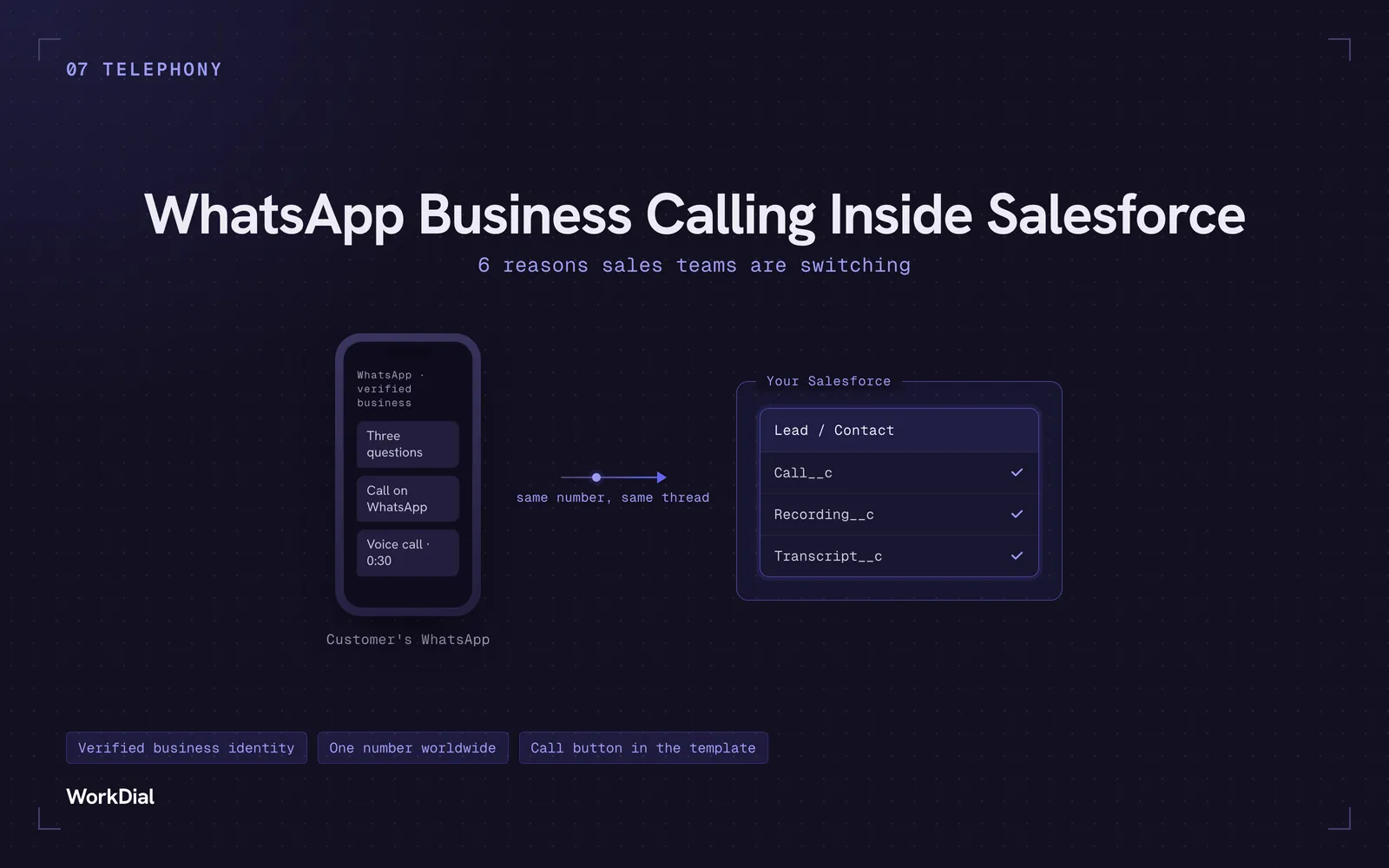
WhatsApp Business Calling Inside Salesforce: 6 Reasons Sales Teams Are Switching
Six reasons sales teams are moving calls onto WhatsApp inside Salesforce: one thread for chat and calls, a verified business identity on every call, one number worldwide, lower cost, a call button in the template, and one record for everything.
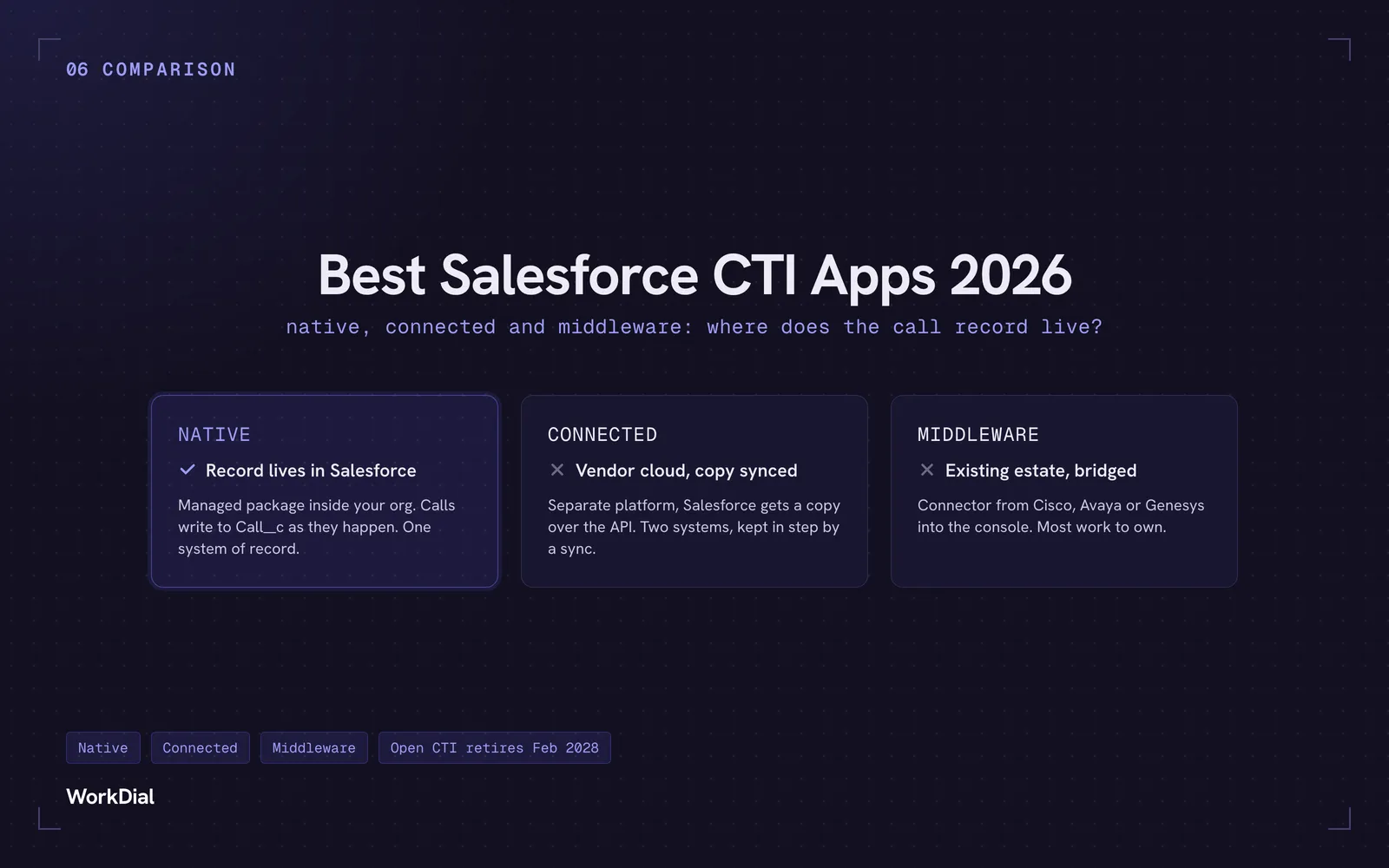
Best Salesforce CTI apps in 2026: native, connected and middleware
The 9 best Salesforce CTI apps in 2026, compared on one thing: where your call record actually lives. Native, connected and middleware, with real pricing.
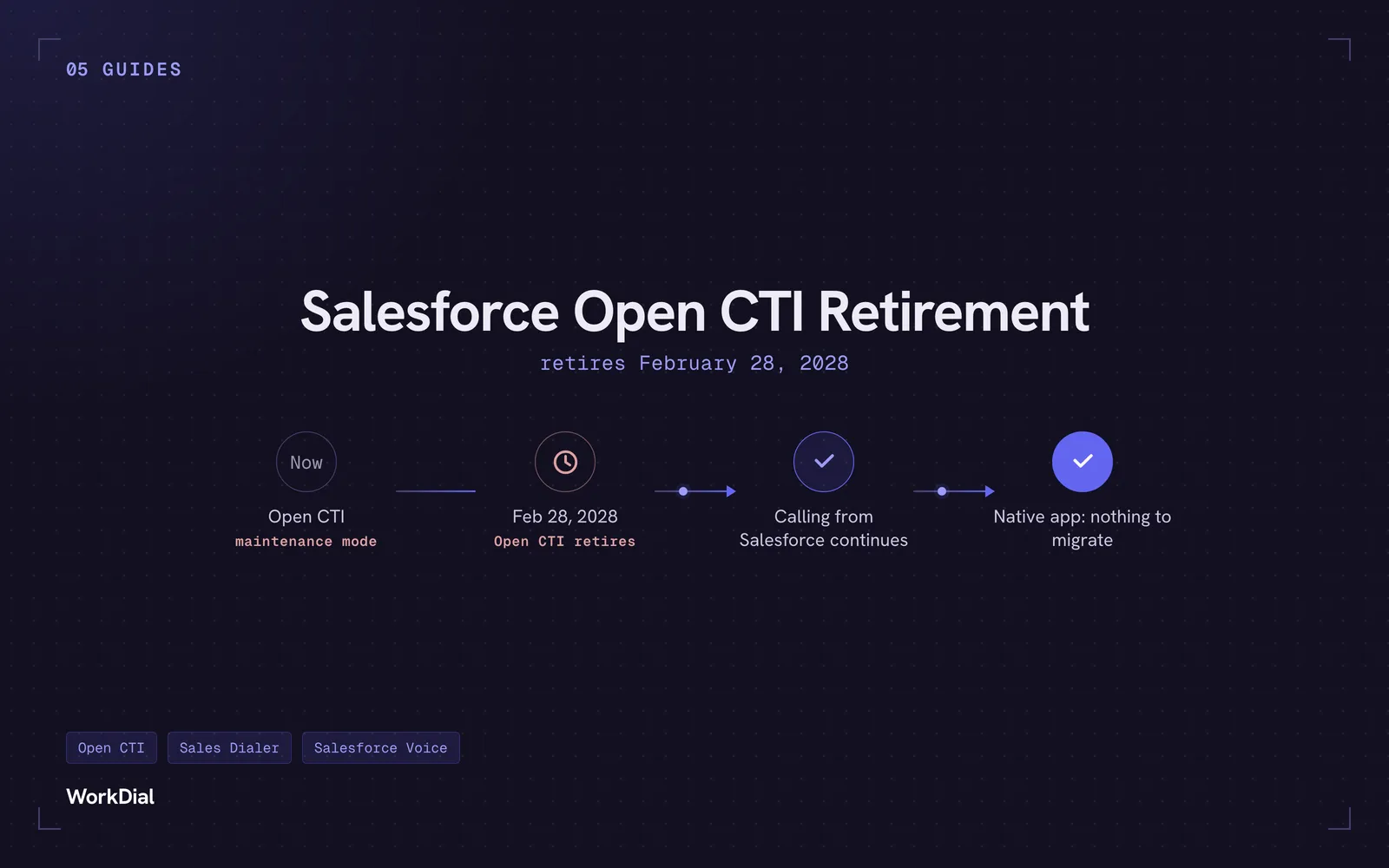
Salesforce Open CTI Retirement: What Actually Happens on February 28, 2028, and Your Real Options
Open CTI retires February 28, 2028. What breaks, what happens to your existing CTI, and how to keep calling in Salesforce without buying new licences.