
Security
Security built on your own Salesforce: your call data, owned by you.
Bolt-on tools hold your conversations in a vendor database. WorkDial is a Salesforce-native CTI platform that keeps no copy of its own: records in your Salesforce, recordings where you choose, one vendor perimeter.
Records in your org · recordings your choice · no WorkDial store
Where does WorkDial keep my call data?
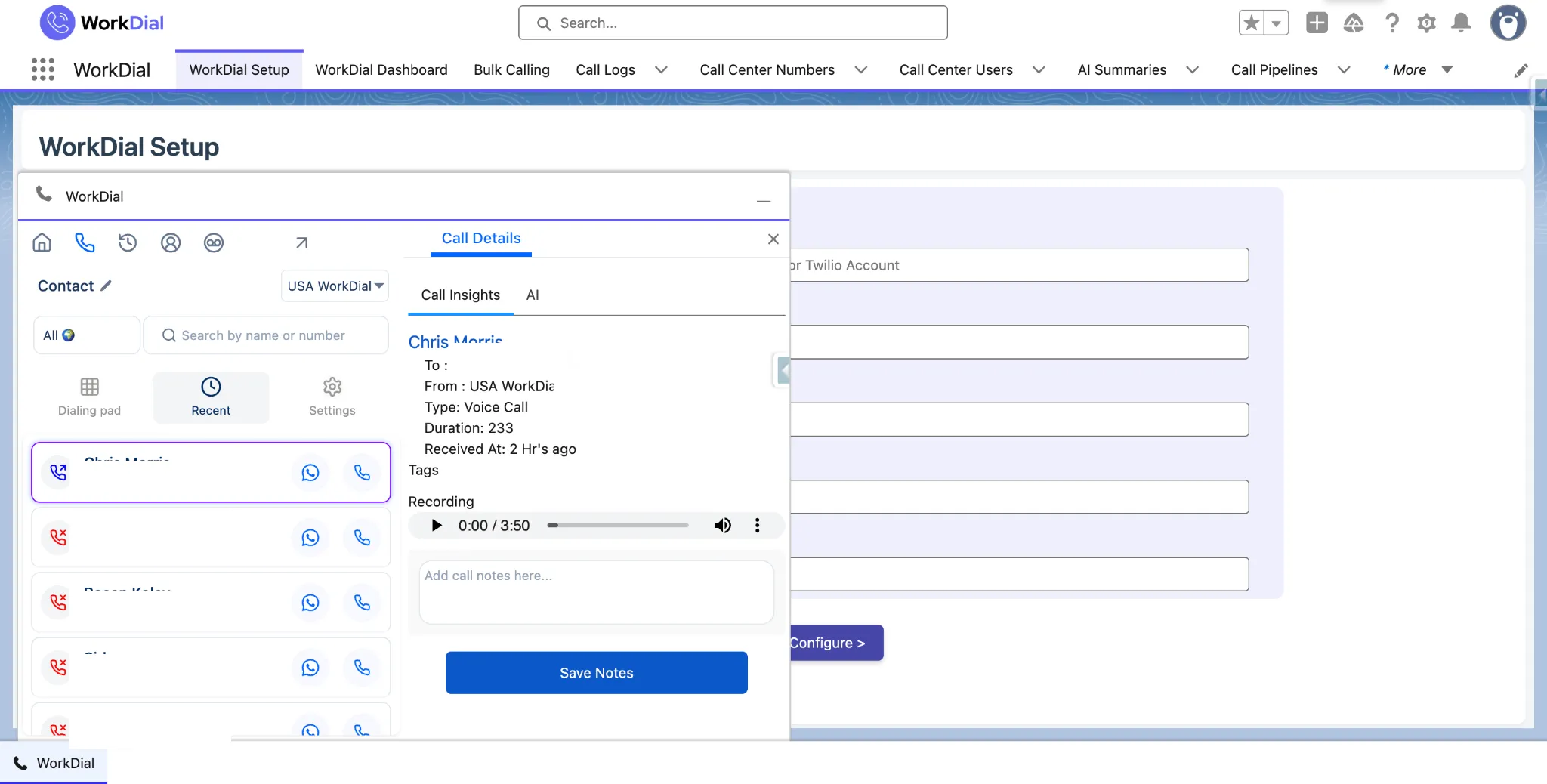
Call records, transcripts, and sentiment are native Salesforce objects (Call__c, Recording__c, Transcript__c, Sentiment__c) inside your own org. You choose where recording audio lives: as native Salesforce Files in your own org, in your own Twilio account, or in your own connected storage. WorkDial operates no external customer data store of its own. The only component outside Salesforce is the telephony transport (your own Twilio account), and it stores none of your data.
The data boundary
One line leaves your org: your own Twilio.
It carries the call and holds none of it. Your credentials, your numbers, your carrier bill at cost with no WorkDial markup. It is your vendor, not ours.
Controls · location
Where your call data lives, and who decides.
Records in your org
Calls, transcripts, and sentiment are Salesforce objects written directly into your org, not synced in from a vendor database.
Recordings: your choice
You pick where the audio lives. Whatever you choose, it is referenced from Recording__c and never duplicated into a WorkDial store.
Data residency
Call records and transcripts are Salesforce objects, so they inherit your org’s region. WorkDial holds no external copy of your customer data to govern in a second place.
Retention & deletion
Your retention rules apply. Delete the record and it is gone, with no external WorkDial copy to chase.
Controls · governance
One audit surface: the Salesforce model you already run.
Because the data lives in your Salesforce, the governance model is Salesforce’s. No second permission system, no separate vendor store to audit, no additional certifications to chase.
Access control
Sharing rules, permission sets, and field-level security already govern the records. There is no second permission model on WorkDial’s side.
Encryption
Encryption posture: inherited from Salesforce, in transit and at rest, with TLS 1.2 or higher in transit. There is no separate WorkDial store to encrypt or certify.
Sub-processors
Named sub-processors cover only features you enable: Meta Platforms, Inc. (WhatsApp voice) and ConvoAgent, Inc. for call analysis. Full list: /dpa/.
Audit & monitoring
Salesforce field history plus login and event monitoring on the native records: the same audit surface you already run for the rest of your Salesforce data.
Security questions, or a vulnerability to report? Email security@workdial.io.
Architecture vs bolt-on
The security surface: one store or two.
Architecture, not a feature scorecard. Every rival CTI is born in a vendor cloud, then synced into Salesforce as a copy: a second system of record. WorkDial keeps one. This is the native-versus-integrated question read as a security boundary.
No external store, no surface to certify
A SOC 2 or ISO report exists to vouch for a vendor’s own data store. WorkDial keeps none: your call data lives in your Salesforce and your own Twilio, under their certifications and your controls. The attack and audit surface those reports would cover does not exist on WorkDial’s side.
Questions
Security, answered
Where does my call data live?
Is anything stored on a WorkDial system?
Where are recordings stored?
How are permissions and access controlled?
Do you support SSO and provisioning?
How do I connect my Twilio account, and does call audio pass through WorkDial?
Are you SOC 2 or ISO 27001 certified?
Is WorkDial HIPAA compliant, or will you sign a BAA?
Do you provide a DPA and a list of sub-processors?
How is data residency handled?
How is data retention and deletion handled?
Get started
Running a security review? Talk to us.
4.97★ across 116 AppExchange reviews · from the team behind  ValueText, the Salesforce-native messaging platform