
Bring your own Twilio: what no markup means
WorkDial uses your own Twilio account for telephony at carrier cost with no markup, so your call minutes and recordings stay billed and stored by you.
WorkDial is a Salesforce-native CTI platform that runs telephony on your own Twilio account, billed at carrier cost with no markup. You hold two separate bills: WorkDial charges for the software per user, and Twilio charges for the minutes directly. The call data lands in Salesforce as a structured record, and the audio recording stays in your own Twilio.
What does “bring your own Twilio” mean?
Bring your own account (BYOA) means WorkDial places and receives calls using Twilio credentials you own, not a phone network WorkDial resells to you. You sign in to Twilio, you hold the numbers, and Twilio bills you for usage. WorkDial uses that account to dial, connect, and record, then writes the structured result into Salesforce.
This is the opposite of how bolt-on dialers usually price telephony. Many integrated CTI tools fold minutes into the per-seat price and take a margin on every minute you use. The margin is rarely itemized, so you cannot read what the carrier charged versus what the vendor added. BYOA removes that layer: the minutes cost what the carrier charges, and you can see it.
Who bills you, for what
There are two bills, and the separation is the point.
| Bill | Charged by | What it covers |
|---|---|---|
| Software subscription | WorkDial | The Salesforce-native CTI platform, per user per month. See WorkDial pricing tiers. |
| Telephony usage | Twilio | Call minutes, numbers, and carrier fees, at carrier rate with no WorkDial markup. |
WorkDial earns from the subscription, not from a per-minute margin. That is why telephony is a separate line you read on your own Twilio invoice. Your calling cost tracks the carrier rate, and your software cost is fixed and predictable. Neither one hides inside the other.
Why carrier-cost telephony matters at volume
At low call volume, a per-minute markup is small enough to ignore. At high volume, it becomes the larger half of the conversation. When minutes carry a vendor margin, your telephony cost scales with that margin rather than with the carrier’s rate, so growth in call activity quietly inflates the part of the bill you cannot itemize. That hidden margin is how a second system of record gets funded: the vendor’s cloud, not your Salesforce org, ends up holding the numbers you cannot see.
BYOA changes the math. Because Twilio bills your account directly, you can negotiate carrier rates as your volume grows, move traffic on terms you set, and forecast cost from a rate you can read. A Salesforce dialer that runs many outbound calls per rep per day is exactly where this separation pays off, because the minute count is high and a hidden margin compounds across every seat.
Where does the recording live, and where does the call data live?
The audio recording stays in your own Twilio account; the structured call data lands in Salesforce as a record. This is the honest version of data residency, and it is worth stating precisely. WorkDial keeps no recording store of its own. The carrier transport and the recording storage live in infrastructure you control through Twilio.
Meanwhile, every call writes to native Salesforce objects, Call__c and Transcript__c among them: call activity, dispositions, and the AI artifacts (transcripts, sentiment, summaries) land on objects in your org, not synced in from a vendor database. Other tools connect to Salesforce. WorkDial runs inside it. If you want the longer argument for why the structured record belongs on the platform, read why call data belongs in Salesforce.
So the split is clean: the call record lives in Salesforce, and the carrier transport and recording sit in your own Twilio. That is the model WorkDial commits to, and it is the model a Salesforce admin can verify against the objects in the org.
How telephony cost relates to the WorkDial subscription
Telephony cost is separate from the WorkDial subscription, and it does not change with your tier. Whether you are on Core, Professional, or Enterprise, the minutes are billed by Twilio at carrier rate. The tier determines the software capability you get inside Salesforce, including how much of the AI analysis is included. Pricing for those tiers lives on the pricing page rather than being restated here. For how telephony minutes and AI add-ons stack into the all-in cost, see the true cost of a Salesforce CTI.
This separation also keeps the buying decision honest. You evaluate the Salesforce CTI architecture on its own terms, and you evaluate telephony cost on the carrier’s terms. Neither decision is bundled into the other, and neither hides a margin inside the other.
If the tool is supposed to manage your Salesforce communication, why does your communication data live somewhere else? BYOA is one half of WorkDial’s answer: the structured record lives in Salesforce, the recording stays in your account, and the minutes are billed to you at cost.
Setting up your own Twilio account
You connect Twilio once, during WorkDial setup, and the account stays yours. The steps are short:
- Create or sign in to Twilio. Sign up at Twilio or use an account you already have. You hold the login, the numbers, and the billing.
- Connect it in WorkDial. On the WorkDial setup page, paste your Twilio credentials. WorkDial uses them to place, receive, and record calls. See the setup steps.
- Start calling. Calls run on your Twilio account and land in Salesforce as call activity, ready to work.
Two things worth checking before you start:
- What Twilio charges. Rates are set by Twilio, not WorkDial, and vary by country and call type. The current Twilio voice pricing page shows the cost per minute on your routes, so you can read the number from the carrier instead of a vendor’s bundle.
- How Twilio handles security. The carrier transport and your recordings sit in your Twilio account, governed by Twilio’s security program, alongside the Salesforce security model that governs the call record.
Confused, or would you rather not set it up yourself? Book a quick setup call and the WorkDial team will connect your Twilio with you, on your own org, at no charge.
Get started
WorkDial connects to your Twilio account during setup and writes every call into Salesforce as a record you can report on, with no per-minute margin in between. Start a trial to connect your account and run real calls, or view a demo if you want to see the record written first.
Common questions
- Who bills me when I use WorkDial with my own Twilio?
- Two parties bill you separately. WorkDial bills the per-user software subscription that runs inside Salesforce. Twilio bills the call minutes at carrier rate with no WorkDial markup. Your telephony cost and your software cost are independent line items you can read on their own.
- Does WorkDial take a margin on my call minutes?
- No. WorkDial adds no markup to telephony. Minutes are billed by Twilio directly to your Twilio account at carrier rate. WorkDial earns from the software subscription, not from a per-minute margin, so your calling cost tracks the carrier rate rather than a vendor's margin.
- Where does my call recording live with bring your own Twilio?
- The audio recording stays in your own Twilio account. WorkDial operates no separate recording store. The call activity, dispositions, transcript, sentiment, and summary are written to Salesforce as structured records, so that record lives in Salesforce while the audio stays in infrastructure you control.
- How much does Twilio charge per minute with WorkDial?
- Twilio sets the per-minute rate, not WorkDial, and it varies by country and call type. Because you bring your own Twilio, you pay Twilio's carrier rate directly with no WorkDial markup. Check the current Twilio voice pricing page for the cost on the routes you call.
- Can I buy WorkDial without a Twilio account already set up?
- You connect a Twilio account during setup. Creating one at twilio.com is part of standard onboarding, and the account stays yours. Because telephony is billed to your account at carrier rate, you keep direct control of credentials, numbers, and carrier rates instead of inheriting a vendor's bundled pricing. If you would rather not set it up yourself, the WorkDial team can connect it with you on a quick call.
Written by WorkDial, The voice layer of Salesforce. WorkDial is built by the team behind ValueText, the Salesforce-native messaging platform, rated 4.97 stars across 116 AppExchange reviews.
Keep reading
Related posts.
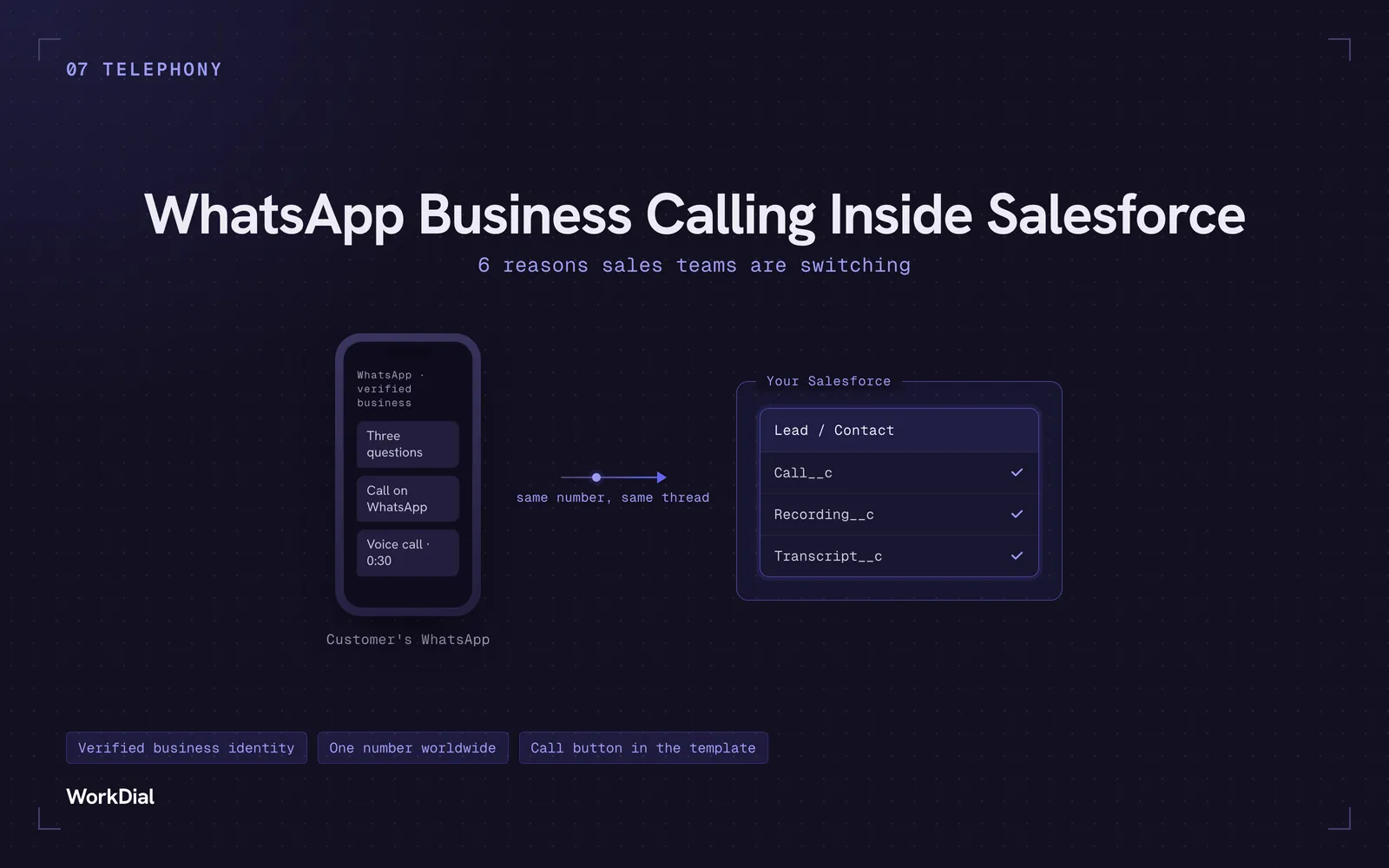
WhatsApp Business Calling Inside Salesforce: 6 Reasons Sales Teams Are Switching
Six reasons sales teams are moving calls onto WhatsApp inside Salesforce: one thread for chat and calls, a verified business identity on every call, one number worldwide, lower cost, a call button in the template, and one record for everything.
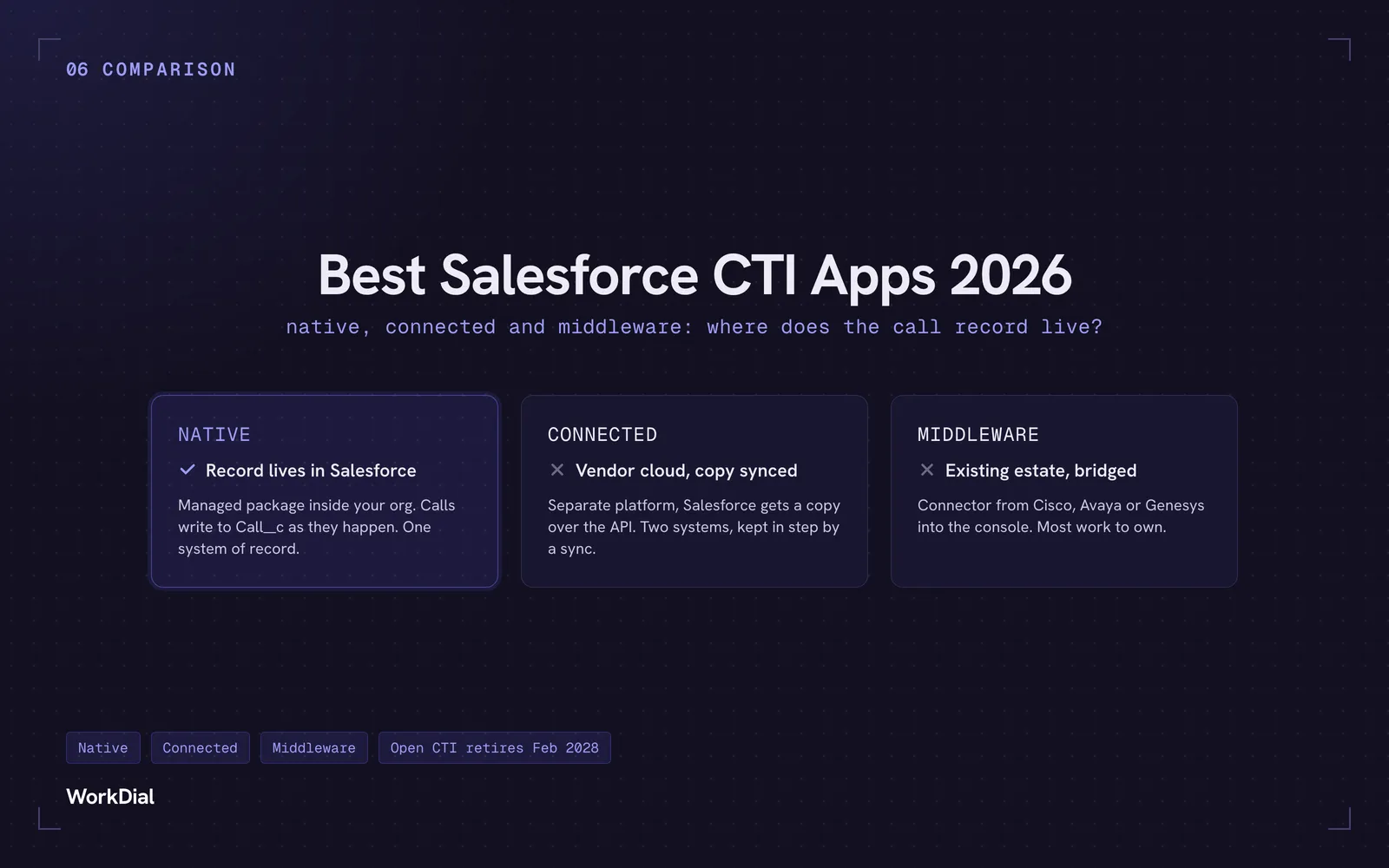
Best Salesforce CTI apps in 2026: native, connected and middleware
The 9 best Salesforce CTI apps in 2026, compared on one thing: where your call record actually lives. Native, connected and middleware, with real pricing.
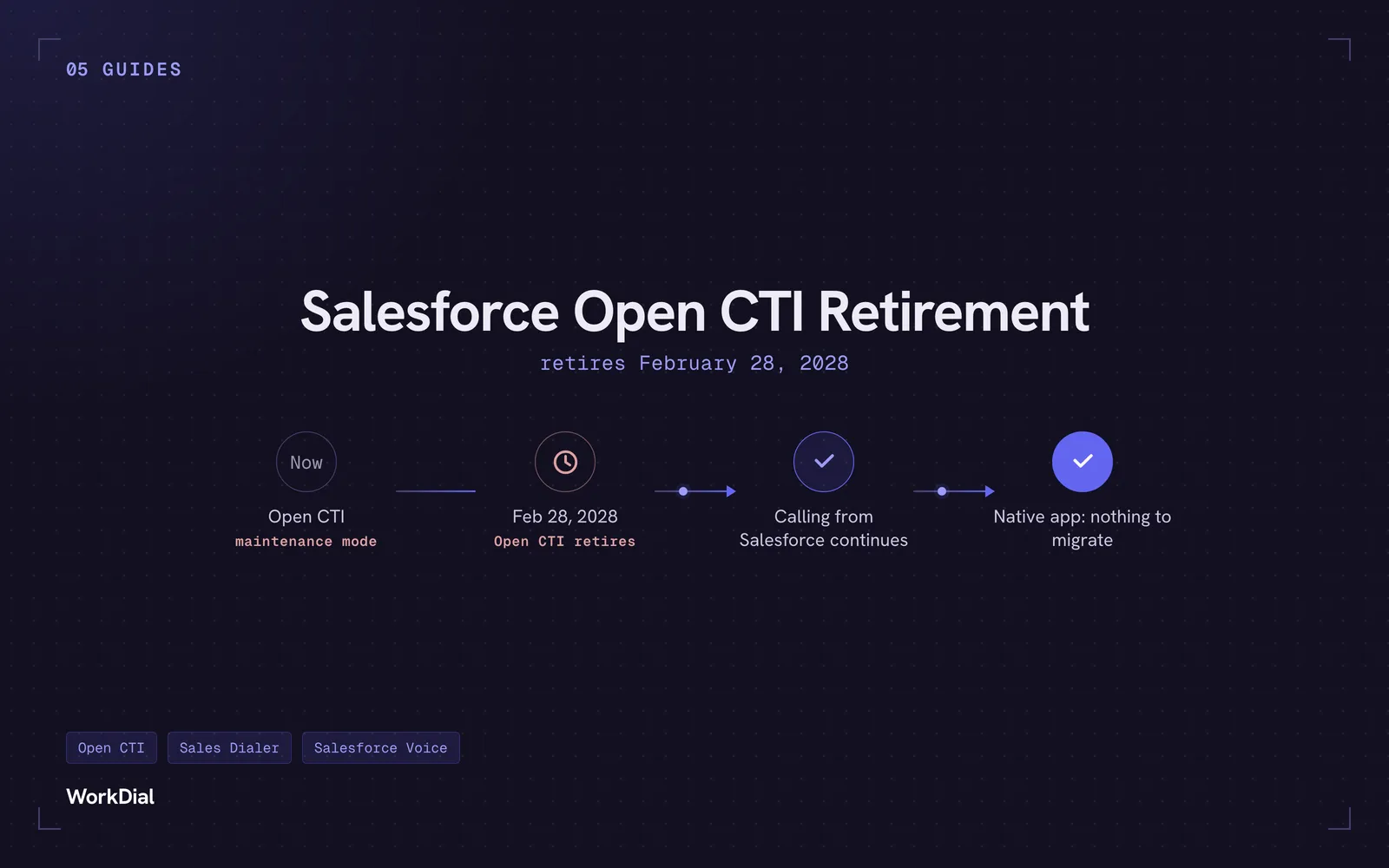
Salesforce Open CTI Retirement: What Actually Happens on February 28, 2028, and Your Real Options
Open CTI retires February 28, 2028. What breaks, what happens to your existing CTI, and how to keep calling in Salesforce without buying new licences.