
You can't coach a sales conversation you never hear
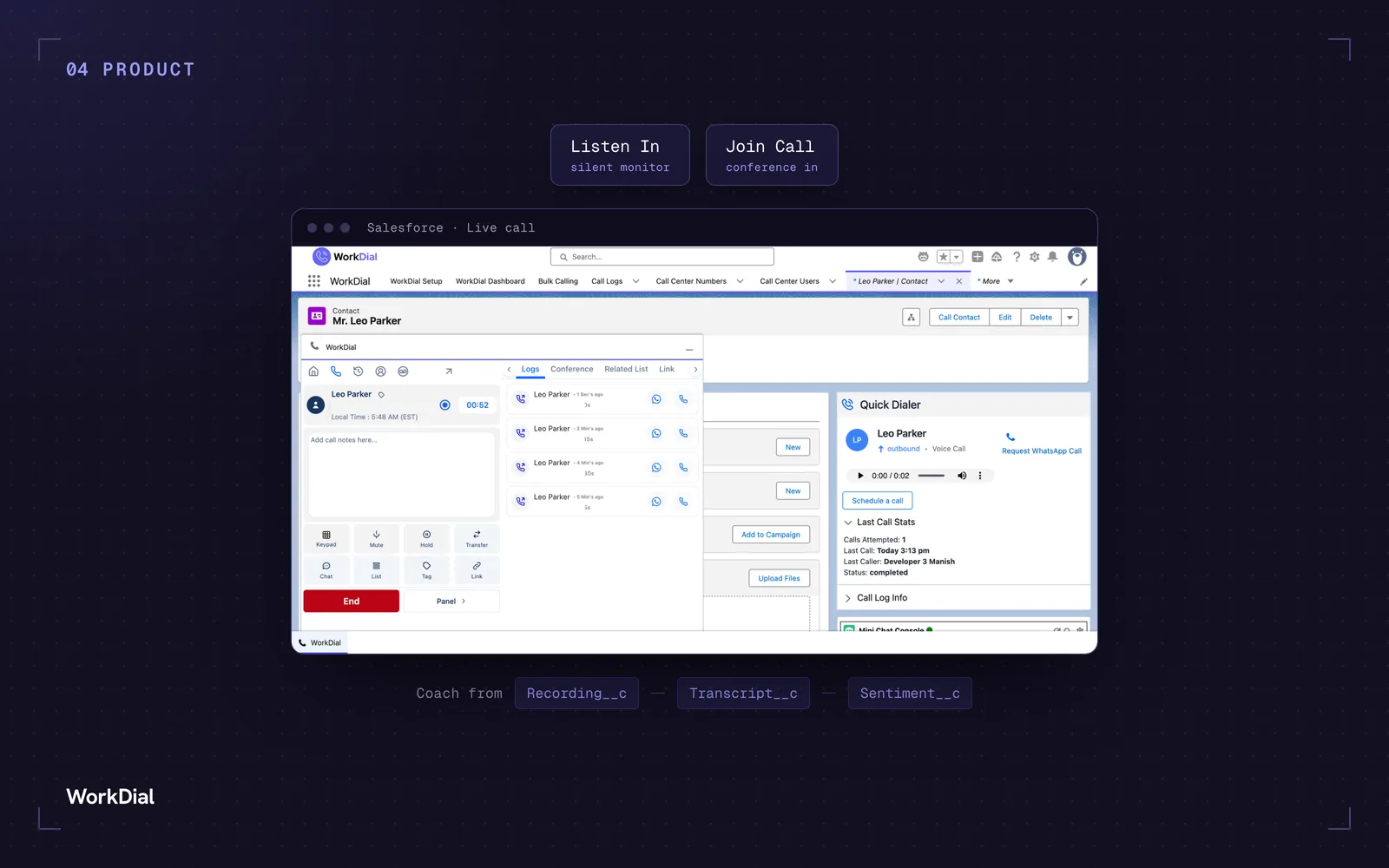
You cannot coach a call you never heard. WorkDial lets a manager Listen In or Join Call live, then coach from the recording and transcript after.
A sales manager asks a rep why a listing lead went cold. The rep tells a story: the client wanted to negotiate, then went quiet. That story is the entire record. The call happened on the rep’s personal WhatsApp, so there is no recording to check, no transcript to read, and no way to hear the tone that might explain the hesitation. The manager is coaching a conversation they never heard, from an account written by the person being coached.
That is the state of sales management on WhatsApp-first real estate teams across South Africa, Singapore, and the UAE. A lead lands from Bayut, Property Finder, or PropertyGuru, gets routed to an agent, and from that point the conversation lives on a personal device. WorkDial’s answer is not a cleaner retelling of what happened. WorkDial puts the conversation itself onto the Salesforce record: the live call and everything it leaves behind. A manager can watch it happen or review it afterward with the same evidence the rep had.
Why does sales coaching break down when calls happen on a personal phone?
Coaching breaks down because the manager’s only source is the agent’s own account of a call nobody else heard. In the buyer’s own words, this is “I have no idea what my team is doing.” A manager cannot listen in, cannot pull a recording, and has no consistent way to score a call against a QA rubric when the call and the client relationship both sit on an agent’s personal WhatsApp.
Every coaching conversation then runs on secondhand information from the person with the least incentive to report a mistake accurately. There is nothing to disagree with, because there is nothing to check the story against. A manager can sense a pattern (deals stalling after the second call, certain listings going quiet) without ever being able to name the moment in a specific conversation that caused it.
How can a manager monitor a live sales call in Salesforce?
A manager can Listen In on a live call to monitor it silently, or Join Call to conference in and take part. Both modes run inside Salesforce Lightning against the call while it is in progress, on the record the rep is working from, not a separate console the manager has to log into.
Listen In lets a manager check how a new rep actually runs a call, or spot-check a call type, without changing the dynamic between the rep and the client. Join Call brings the manager onto the line itself, for a deal that needs a second voice right now. Neither mode requires advance notice from the rep: the active call is visible from Salesforce, not from an agent’s phone.
What is the difference between Listen In and Join Call?
Listen In is silent observation. Join Call is active participation. The choice between them is the manager’s, made call by call.
Listen In answers “how is this rep actually running a call?” without the client knowing a second person is present. Join Call answers “does this deal need me right now?” and puts the manager on the line as a third voice. A ramping new hire gets volume through Listen In; a stalled six-figure listing gets one conversation’s worth of Join Call. Both sit on the same call record, so a manager never has to open a separate monitoring tool to use either one.
How do you coach a rep on a call you missed?
You coach from the recorded call, the transcript, the sentiment score, and the AI summary, all written to the Salesforce record the moment the call ends. A manager cannot Listen In on every call a team runs in a day, and does not need to: the record carries the same material for a call missed live as for one monitored in real time.
That changes what coaching sounds like. Take the listing lead that went cold from the opening example. Instead of asking the rep to reconstruct a conversation from memory, the manager opens the call record, reads the transcript to the point where the client’s answers shorten, and checks the sentiment score against that same stretch. Instead of “walk me through what happened,” the manager says “let’s listen to the part at 4 minutes 20 where your tone shifted right after you named a number.” That is a different conversation with the rep, grounded in what the client actually heard rather than in what the rep remembers saying. The underlying analysis is covered in more depth on AI call analysis inside Salesforce.
Does this extend to the WhatsApp voice calls agents already run?
Yes. A WhatsApp voice call placed from the Salesforce record is recorded and logged the same way a regular phone call is. In WhatsApp-first markets, most of the sales conversation is not a phone call, it is a WhatsApp voice call the agent places from a chat opened on the record, without ever seeing or owning the client’s number.
Because that call runs through WorkDial rather than the agent’s personal WhatsApp, it produces the same recording, transcript, and sentiment score a manager coaches from, on the channel the client actually uses. That closes the QA gap this post opened with, and it is the same architecture question behind WhatsApp lead ownership in real estate: where the conversation lives decides who can coach it, and who keeps it when an agent leaves.
What does this change for RevOps reporting?
Manager reporting reads from the same native Salesforce objects the reps’ calls write to, not a second QA tool that may not agree with the CRM. Call outcomes, transcripts, sentiment, and summaries land on those objects the moment a call happens, so a call-quality dashboard is a standard Salesforce report.
Picture the two ways this plays out. Before: a QA lead exports call logs from a dialer console, matches them against Salesforce by hand, and finds gaps where a call outcome never synced, so this week’s coaching list is already stale by the time it is built. After: the QA lead opens a standard Salesforce report filtered on sentiment score and call outcome, because the call, the transcript, and the score were written to the record when the call ended, not synced in afterward.
RevOps sets a QA rubric once and applies it against real conversations instead of retellings, and a manager’s coaching notes sit next to the record the rep worked from. That is why the reporting a manager trusts and the record a rep works from are the same object, not two systems reconciled after the fact. What that means day to day for reps and managers is covered on how WorkDial works inside Salesforce.
The manager does not have to trust a rep’s memory
None of this asks a manager to take a rep’s word for what happened on a call. The record does the remembering: who said what, how it landed, and what the manager did about it afterward. A team that runs Listen In, Join Call, and record-based coaching from the same account is running one QA process, not stitching together a live check here and a memory-based debrief there. WorkDial is built by the team behind ValueText, the Salesforce-native messaging platform with 4.97 stars across 100+ AppExchange reviews, applying the same native-record approach to voice.
Start your trial and turn on Listen In and Join Call in your own Salesforce org, no card required: Start your trial. Want to watch it work first? See it live.
Common questions
- How can a manager monitor a live sales call in Salesforce?
- A manager can open an active call from Salesforce and choose Listen In to monitor it silently, or Join Call to conference in and take part. Both modes run against the call while it is in progress, on the record the rep is working from, so a manager does not need to be told a call is happening or guess which line a rep is on.
- What is the difference between Listen In and Join Call?
- Listen In is silent monitoring: the manager hears the call and the client does not know a second person is on the line. Join Call brings the manager onto the call as a participant, for a deal that needs a second voice or a coaching moment that cannot wait for the debrief. Both are native Salesforce capabilities on the same call record, and the choice of which to use is the manager's on a call-by-call basis.
- How do you coach a rep on a call you missed?
- You coach from what the call leaves behind: the recording, the transcript, the sentiment score, and an AI summary, all written to the Salesforce record the moment the call ends. That gives a manager the same material for a call they missed as for one they monitored live, so coaching runs on what was actually said rather than on the rep's own retelling of it.
- Does call monitoring and coaching extend to WhatsApp voice calls?
- Yes, when the WhatsApp voice call is placed from the Salesforce record rather than an agent's personal WhatsApp. WorkDial records and logs that call automatically, producing the same transcript and sentiment score a manager coaches from on a regular phone call, on the channel real estate clients actually use.
- Where do call recordings and transcripts live for coaching?
- On native Salesforce objects (Call__c, Recording__c, Transcript__c, Sentiment__c) attached to the record the moment the call happens. A manager pulls up that record to review the recording, read the transcript, or check the sentiment score, instead of opening a separate QA tool that may not agree with the CRM.
Written by WorkDial, The voice layer of Salesforce. WorkDial is built by the team behind ValueText, the Salesforce-native messaging platform, rated 4.97 stars across 116 AppExchange reviews.
Keep reading
Related posts.
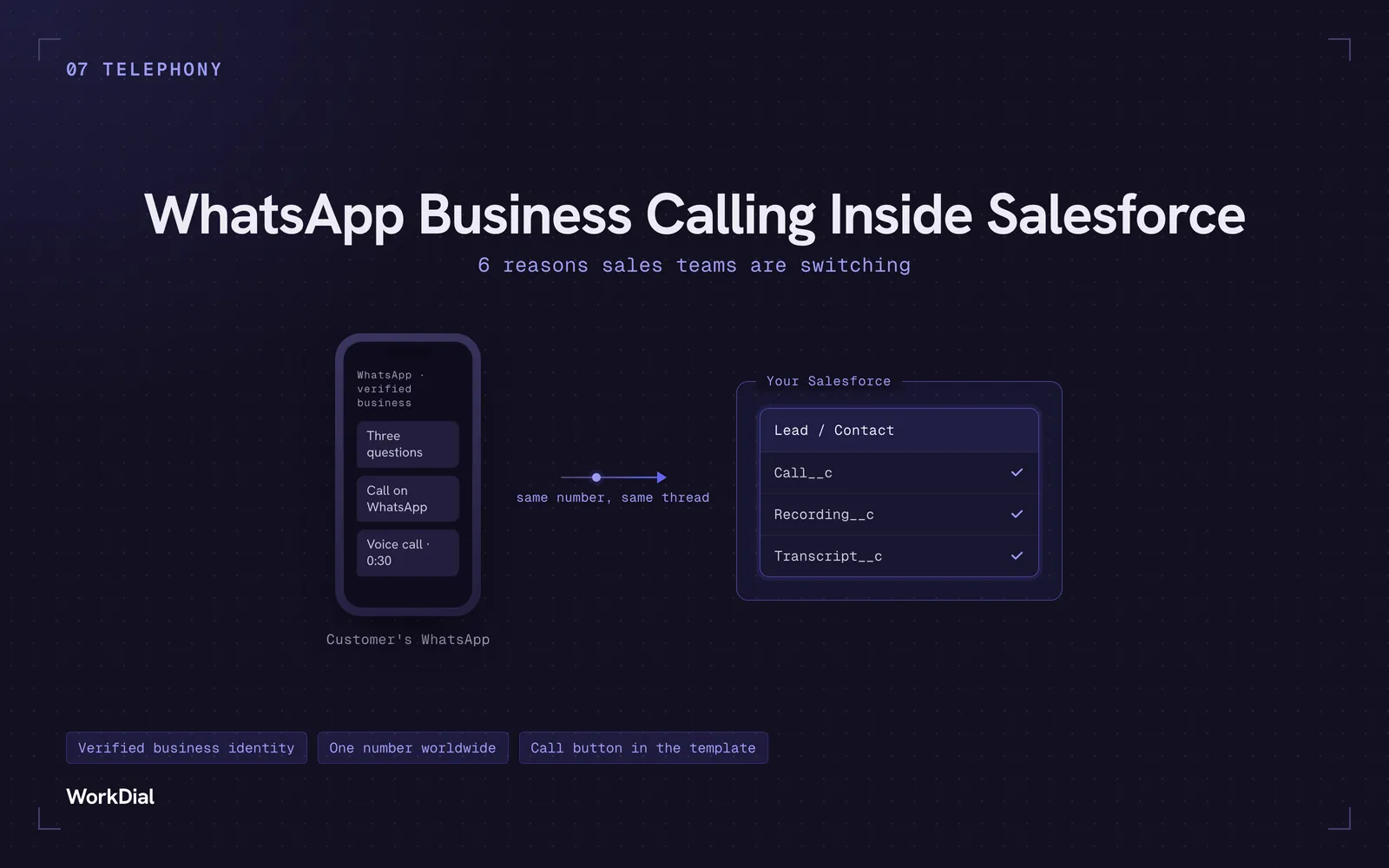
WhatsApp Business Calling Inside Salesforce: 6 Reasons Sales Teams Are Switching
Six reasons sales teams are moving calls onto WhatsApp inside Salesforce: one thread for chat and calls, a verified business identity on every call, one number worldwide, lower cost, a call button in the template, and one record for everything.
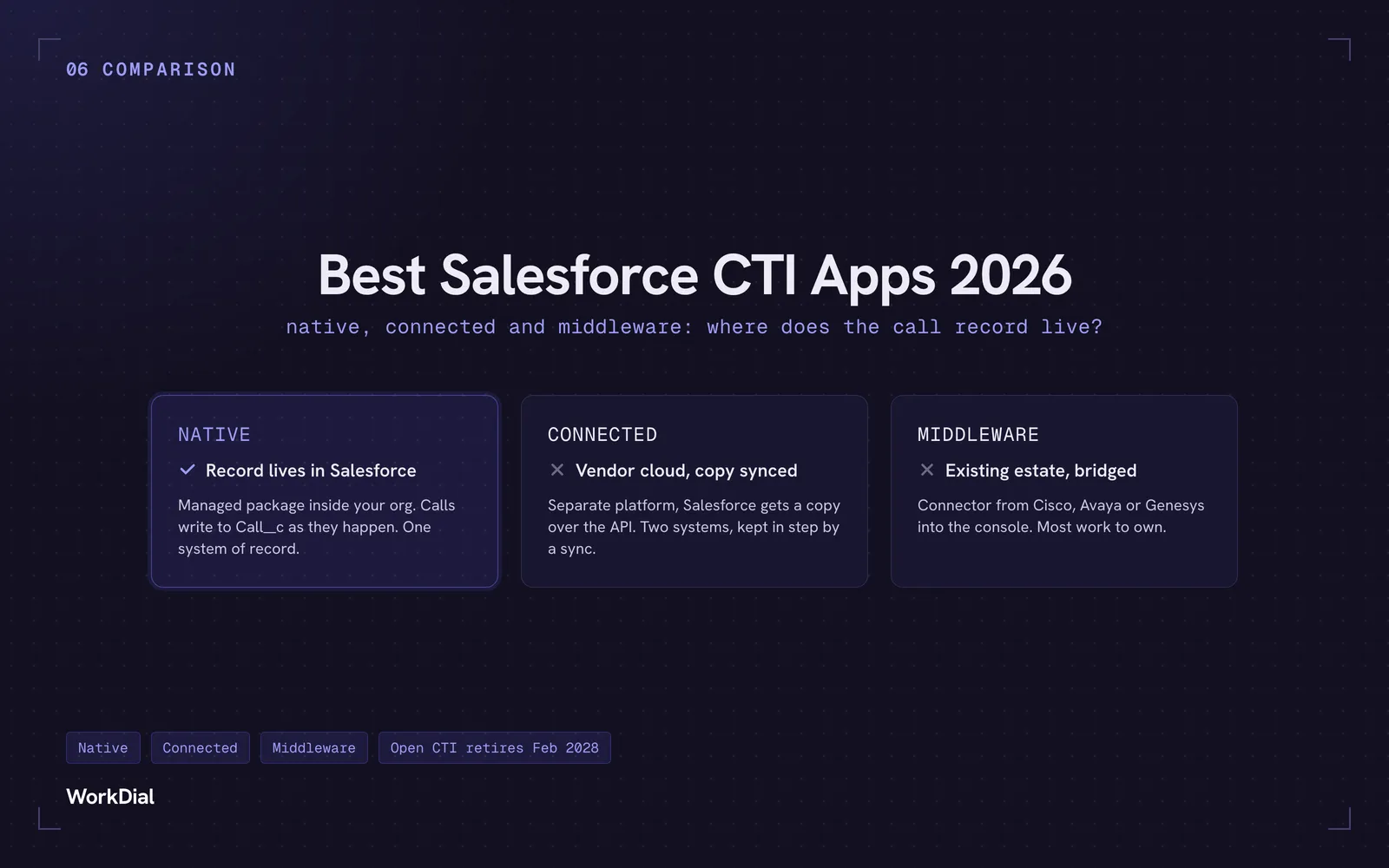
Best Salesforce CTI apps in 2026: native, connected and middleware
The 9 best Salesforce CTI apps in 2026, compared on one thing: where your call record actually lives. Native, connected and middleware, with real pricing.
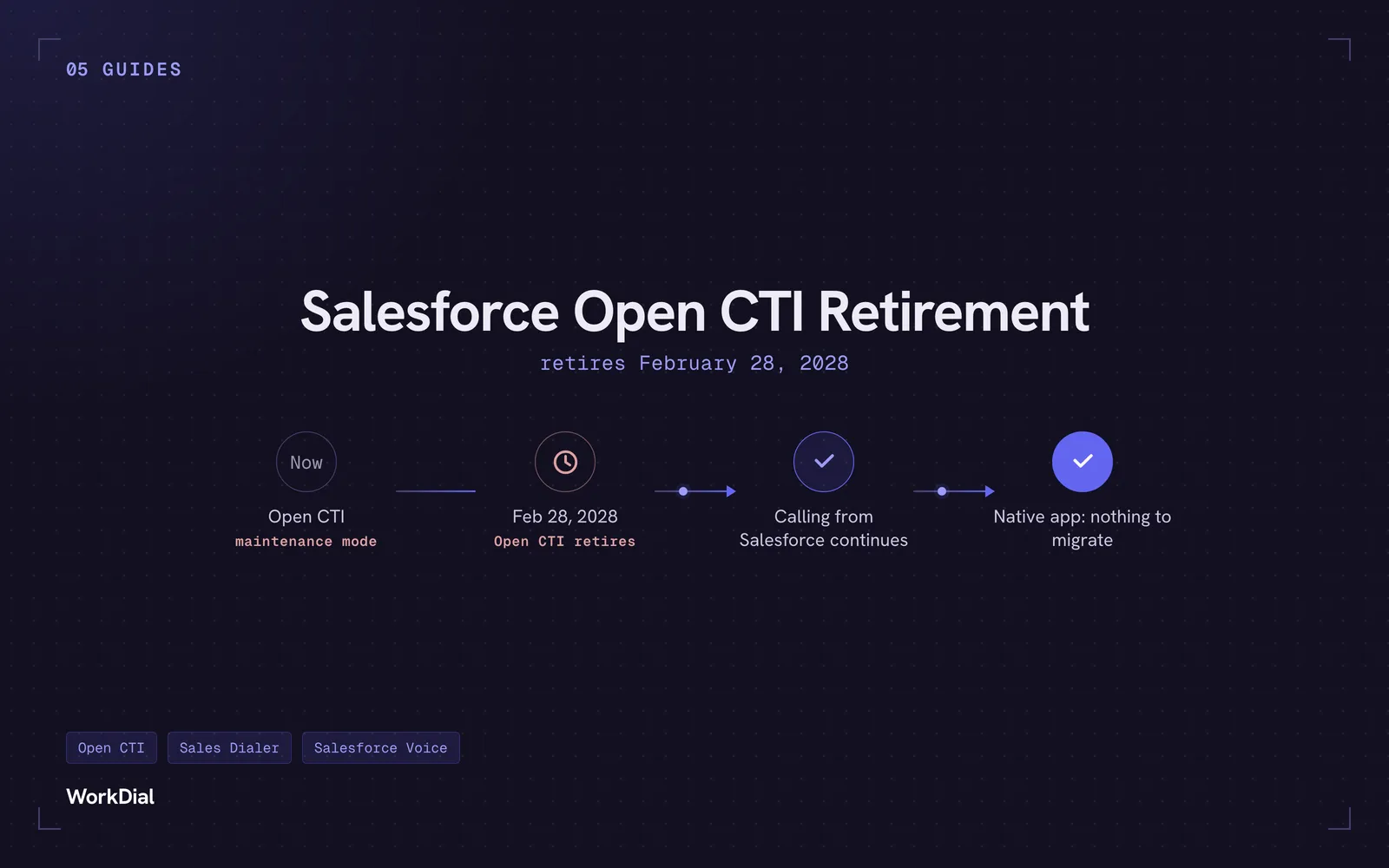
Salesforce Open CTI Retirement: What Actually Happens on February 28, 2028, and Your Real Options
Open CTI retires February 28, 2028. What breaks, what happens to your existing CTI, and how to keep calling in Salesforce without buying new licences.